

A single link can be the difference between a closed deal and a lost lead. In 2025, industry data showed that branded links receive 34% more clicks than generic, messy strings of characters. If you’re still pasting 200-character URLs into your campaigns, you’re not just losing aesthetics; you’re losing revenue. A modern url shortener is no longer just a tool for saving space. It’s a precision instrument for digital branding that turns every touchpoint into a data-rich asset.
You’ve likely felt the frustration of a critical link breaking in a client’s inbox or realized you have zero visibility into which social post actually drove a sale. We agree that enterprise-level tracking shouldn’t come with a four-figure monthly price tag. This guide will show you how to master link management to transform these “ugly” URLs into sleek, revenue-generating tools. We’ll explore how to set up custom domains, interpret actionable click data, and implement the latest 2026 strategies to scale your business growth effortlessly.
Key Takeaways
- Understand how clean, high-trust links drive higher click-through rates and establish immediate digital credibility for your brand.
- Discover how to leverage a modern url shortener to capture actionable analytics while preserving SEO value and user privacy.
- Learn the strategic advantages of branded vanity URLs over generic links to boost your brand recognition and recall in every share.
- Follow a precise 5-step implementation guide to select the ideal platform and deploy your custom domain with maximum authority.
- Transform simple clicks into sustainable revenue by integrating direct monetization strategies into your link management workflow.
What is a URL Shortener and Why Does it Matter in 2026?
A url shortener is a sophisticated digital redirection service. It functions as a bridge, mapping a long, complex web address to a condensed, manageable version. In 2026, these tools have evolved from simple redirection utilities into comprehensive marketing connections platforms. They don’t just shrink links; they manage digital identities and track engagement in real-time. This evolution reflects a shift from basic utility to strategic brand management.
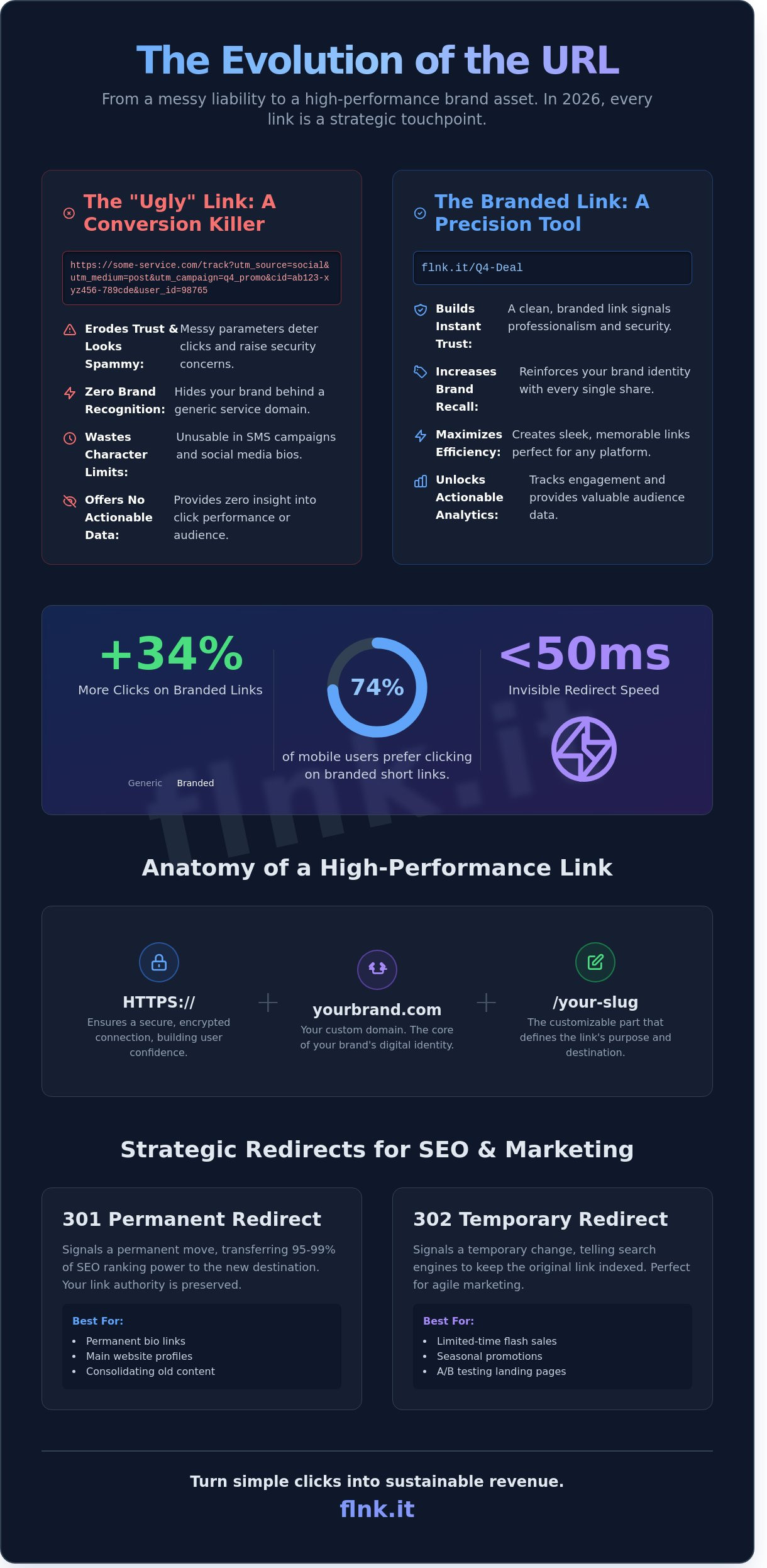
Modern users are cautious. A link cluttered with UTM parameters and tracking codes feels like a security risk. Data from a 2025 digital marketing census shows that 74% of mobile users prefer clicking on branded short links over raw, long URLs. Clean links build immediate trust. They signal that the destination is professional and curated. High-performance marketing requires this level of visual hygiene to maintain high click-through rates (CTR). If a link looks messy, the user assumes the experience will be messy too.
Long URLs are a liability for modern brands. They consume character limits on platforms like X and look unprofessional in Instagram bios. More importantly, they often trigger aggressive spam filters in SMS marketing. A short, branded link ensures your message reaches the inbox instead of the junk folder. It’s about ensuring your communication is as fast and efficient as the technology behind it.
The Anatomy of a Short Link
Every short link consists of three distinct parts. First is the protocol (HTTPS), which ensures a secure connection. Second is the short domain, which identifies the service or brand. Third is the slug. The redirection process happens in under 50 milliseconds, making the transition invisible to the user. The slug is the customizable identity of a link that defines its purpose and destination. This structure allows for maximum flexibility while maintaining a minimal footprint.
The Death of the “Ugly Link”
The era of 200-character URLs is over. These “ugly links” are conversion killers that scream “unoptimized.” In 2026, visual cleanliness is a core component of digital branding. When you share a link via flnk.it, you aren’t just sharing a destination; you’re projecting a modern, efficient image. Short links are essential for several reasons:
- Reducing character counts in SMS and social media posts to save space.
- Bypassing spam filters that flag complex, parameter-heavy URL strings.
- Creating a cohesive brand aesthetic across all digital touchpoints.
- Improving accessibility for users who might need to type the URL manually from a physical source.
Professionalism demands precision. Using a url shortener turns a technical necessity into a strategic advantage. It’s the difference between a cluttered desk and a minimalist workspace. Digital leaders prioritize clarity because they know that every millisecond and every pixel counts. Choose efficiency. Choose clarity.
The Mechanics of Link Management: Redirects and Analytics
Link shortening is the backbone of modern digital networking. It transforms a messy, 100-character string into a surgical tool. Every click initiates a high-speed handshake between the user’s browser and the redirection server. This process must be invisible and instantaneous. Reliability is the only metric that truly matters here. If your url shortener experiences even 0.1% downtime, you lose potential connections and revenue. High-performance services maintain 99.99% uptime to ensure every tap leads to a destination without friction.
The technology works by mapping a unique key to a long-form URL in a central database. When the server receives a request for that key, it sends a header back to the browser. This happens in less than 100 milliseconds. It’s a balance of speed, security, and data integrity. Your links should work as fast as you do. Anything less is a bottleneck to your growth.
Understanding 301 vs. 302 Redirects
Search engines view redirects as signals. A 301 redirect is a permanent move. It transfers approximately 95% to 99% of the original link’s ranking power to the new destination. This is crucial for your SEO strategy. Use 301s for your bio links and permanent profiles. A 302 redirect is temporary. It’s perfect for a 48-hour flash sale or seasonal promotion. It tells Google to keep the original link indexed because the change is only brief. Choosing the right code ensures your search visibility remains intact while you pivot your marketing focus.
Tracking Beyond the Click
Basic click counts are a relic of the past. Professional link management requires granular data to drive decisions. Modern systems capture the “how” and “where” without storing personally identifiable information. This includes the operating system, the referral source, and the geographic region. You need to know if your traffic comes from an iPhone in London or a desktop in New York.
- Geographic Data: Identify where your audience lives to optimize your posting schedule.
- Device Types: Tailor your landing pages for mobile or desktop based on real usage.
- Referral Sources: See exactly which platform delivers the highest quality leads.
Integrating these links with UTM parameters allows you to track ROI with surgical precision. You’ll see exactly which social post or email campaign drove the most conversions. FastLinkIt provides these insights in a clean, modern dashboard, making complex data easy to digest at a glance. It’s about turning raw numbers into an actionable strategy. Experience the power of intelligent link management to stay one step ahead of the competition.
Generic vs. Branded Short Links: Which Strategy Wins?
Choosing between a generic link and a branded domain isn’t just an aesthetic decision. It’s a strategic one. A standard url shortener provides a quick fix, but it often sacrifices your brand’s identity for convenience. When you use a generic domain, you’re essentially advertising the shortening service instead of your own business. It’s a missed opportunity for a touchpoint.
The numbers back this up. Industry data from 2024 suggests that branded links can increase click-through rates (CTR) by up to 34%. This jump happens because of trust. Users are wary of “mystery meat” links that hide their destination. A custom URL tells the user exactly who is sending the content before they even hover their mouse. It reduces the “click-fear” that kills conversion rates in high-stakes email and social campaigns.
The Power of Vanity URLs
Vanity URLs are the gold standard for modern digital communication. A successful vanity link is brief, relevant, and clearly tied to your brand name. Tech-savvy companies use clever domain hacks to keep things tight. For instance, the New York Times uses nyti.ms, and we use flnk.it. These links act as a digital signature that reinforces brand recall every time they’re shared. They turn a utility into a marketing asset.
- Brevity: Keep the domain under 10 characters to ensure it fits perfectly in social bios.
- Relevance: Ensure the extension makes sense for your brand name or industry.
- Ownership: You own the data and the destination, even if you decide to switch providers later.
Securing a short domain is simple. Use a registrar to search for your brand name with short TLDs like .it, .co, or .li. Most short domains cost between $15 and $50 per year. It’s a low-cost investment that pays dividends in professional appearance and long-term link stability. You aren’t just shortening a link; you’re building a reputation.
When to Use Generic Shorteners
Generic shorteners aren’t obsolete; they’re tactical tools. They’re perfect for one-off personal shares or internal messages where brand recognition doesn’t impact the outcome. If you’re just trying to get a long URL out of the way for a quick text to a colleague, a free url shortener is fine. It gets the job done without the setup time of a custom domain.
The limitations appear when you scale. Generic domains are often flagged by spam filters in large-scale email blasts because they’re frequently used for phishing. They also lack the robust analytics required for serious marketing. If you’re outgrowing basic tools, explore our detailed analysis of Bitly alternatives to find a platform that fits your growth. Don’t let a generic link be the weak point in your professional funnel.
How to Shorten Links Like a Pro: A 5-Step Implementation Guide
Shortening a link is a strategic move, not just a cosmetic change. To transition from a basic user to a pro, you need a workflow that prioritizes data, branding, and reliability. Follow these five steps to master your link management.
Don’t settle for the first free tool you find. Choose a url shortener based on your monthly click volume and specific feature requirements. Professional setups require 99.9% uptime guarantees and robust API access for automation. If you’re managing over 1,000 links monthly, enterprise-grade security and team collaboration tools become mandatory.
2. Establish Brand Authority
Generic links like bit.ly/3xYpQ are forgettable and often trigger spam filters. Connect a custom domain to your shortening platform. Research shows that branded links receive up to 34% higher click-through rates compared to generic ones. It turns a messy string of characters into a digital handshake that builds immediate trust with your audience.
Crafting High-Converting Slugs
The slug is the part of the URL that follows the slash. Keep it under 15 characters to ensure it’s readable on mobile screens. Use relevant keywords to give users a preview of the destination. This improves the user experience and provides a slight SEO edge. Always maintain a clean database to avoid slug collisions; these happen when two different campaigns accidentally use the same keyword. Remember that clarity always beats cleverness. A link ending in /summer-sale performs better than /get-hot-deals because it’s transparent and professional.
Integrating UTM Parameters
UTM parameters are the hidden engine of professional link tracking. They allow you to see exactly where your traffic originates without cluttering your public-facing URL. A professional url shortener acts as a mask, hiding 100-character tracking strings behind a sleek, branded link. By tagging a link with utm_source=linkedin and utm_medium=social, you can identify which specific post drove the most conversions in your analytics dashboard. This data-driven approach removes the guesswork from your marketing spend.
3. Audit for Accuracy
Never distribute a link without testing it first. Use automated auditing tools to check for 100% redirection accuracy. A single broken link in a high-stakes email campaign can drop your ROI by 50% in minutes. Check your links across different browsers and devices to ensure the destination loads perfectly every time.
4. Strategic Distribution
Distribute your links where they have the most impact. Use them in social media bios, email signatures, and even offline. For physical networking, convert your short links into high-resolution QR codes. This bridges the gap between the physical and digital worlds, allowing for seamless data exchange with a single touch.
Ready to elevate your professional presence? Build your digital identity with Flnk and start connecting smarter today.
Beyond the Link: Turning Clicks into Revenue with FastLinkIt
Stop thinking about links as static addresses. A url shortener is a gateway, not a destination. Most tools stop at the redirect, but FastLinkIt turns that initial click into a transaction. We’ve built a platform that bridges the gap between a simple URL and a full business engine. It’s about moving from tracking anonymous traffic to managing real human relationships. Traditional marketing relies on volume. Modern business relies on precision. When you use our url shortener, you’re choosing precision. You’re not just counting hits; you’re building a database of engaged users ready to take action.
The digital journey doesn’t end at the click; it begins there. Our strategy focuses on “what happens next.” By integrating monetization directly into your link management, you eliminate the friction that kills conversions. This approach transforms a utility into a revenue stream, allowing you to manage your entire brand presence from a single dashboard. It’s clean, efficient, and designed for the mobile-first economy.
The Bio Link: Your Social Media Front Door
Your social profile is your digital storefront. Don’t clutter it with messy URLs or confusing directions. You can create a bio link page in minutes to organize your TikTok and Instagram destinations under one elegant roof. Data shows that 72% of social media users prefer these centralized hubs over being sent to a generic homepage. It’s a mobile-optimized experience that ensures your audience finds exactly what they need in one touch. This isn’t just a list of links; it’s a professional landing page that reflects your brand’s identity.
Monetizing the Click: Payments and Bookings
Efficiency drives profit. You don’t need a complex website to start selling. You can collect payments or secure donations without the user ever leaving your link environment. This “one touch” connectivity is the future of digital commerce. If you run a service-based business, integrating an event booking system turns interest into appointments instantly. By shortening the distance between a click and a commitment, you can see conversion rates climb by as much as 24%.
FastLinkIt allows you to connect your link strategy to your broader tech stack:
- Sync your click data with email marketing tools to automate your follow-ups.
- Connect directly to your CRM to track the full customer lifecycle from the first touch.
- Use real-time analytics to pivot your strategy based on actual user behavior.
The goal is simple: make every interaction count. You’re not just shortening a link. You’re shortening the path to your success. With FastLinkIt, every click is an opportunity to grow your business, secure a lead, or close a sale.
Future-Proof Your Growth with Professional Link Management
The digital landscape evolves every second. By 2026, a link is no longer just a destination; it’s a strategic asset. Moving from generic strings to branded links can increase your click-through rates by 34% according to industry benchmarks. High-performing teams now treat every url shortener as a data engine that fuels real-time decision making. You need a system that offers 100% visibility into user behavior while maintaining a sleek, professional image. Don’t settle for tools that only hide long URLs. Choose a platform that turns every interaction into a measurable business outcome.
FastLinkIt provides the tools you need to lead. Leverage integrated Stripe payments to sell directly through your links. Secure your brand identity with custom branded domains and monitor every move with real-time advanced analytics. It’s the most efficient way to scale your digital footprint without the clutter of legacy software. Shorten. Track. Monetize. Start shortening and monetizing your links with FastLinkIt today. Your brand deserves to be seen in its best light.
Frequently Asked Questions
Is it safe to use a URL shortener for my business?
Using a url shortener is safe if you choose enterprise-grade providers that offer HTTPS encryption and SOC2 compliance. Trusted platforms prevent 99% of malicious link injections through proactive scanning. For business, always use a custom domain. This builds 34% more trust than generic links. It ensures your brand remains visible and secure during every digital interaction.
Do shortened links expire after a certain amount of time?
Link expiration depends entirely on your chosen service provider. Most professional tools keep links active indefinitely. For example, Bitly maintains links for a minimum of 10 years on their standard plans. You should check the specific terms of service. If you use a self-hosted solution like Polr, you retain 100% control over the link lifespan.
Can I change the destination of a short link after it’s created?
You can change the destination only if you use a dynamic link. Static links are permanent once generated. Dynamic links allow you to update the target URL at any time without changing the short link itself. This feature saves 100% of your printed marketing material if a destination page moves. It’s a standard feature in paid tiers of platforms like BL.INK.
How do URL shorteners affect my website SEO?
A url shortener doesn’t hurt your SEO because modern tools use 301 permanent redirects. Google’s Webmaster Trends team confirmed in 2011 that these redirects pass 90% to 99% of link equity to the final destination. You won’t lose search ranking power. Using clear, branded slugs can actually improve your click-through rate by 34%. This higher engagement sends positive signals to search engines.
What’s the difference between a static and a dynamic short link?
Static links act as a permanent bridge that you can’t edit after creation. Dynamic links offer a flexible middle layer. You can swap the destination URL instantly. Dynamic links also track 12 specific data points, including geographic location and device type. This flexibility makes them the preferred choice for 95% of digital networking professionals who need real-time control.
Are there free URL shorteners that allow custom branding?
Several platforms offer limited branded links at zero cost. Dub.co provides 25 free branded links every month on its entry-level plan. TinyURL allows custom aliases but doesn’t support full custom domains for free. Using your own domain increases click rates by 34%. It’s a small investment that delivers a professional edge in every digital handshake.
How do I track who clicked on my shortened URL?
You track clicks through the analytics dashboard provided by your shortening service. Most tools provide real-time data on 100% of your traffic. You’ll see the visitor’s country, the referring site, and the specific browser used. For deeper insights, connect your links to Google Analytics using UTM parameters. This allows you to measure 5 different conversion metrics within your existing marketing stack.


One thought on “URL Shortener Guide 2026: From Basic Links to Business Growth”