
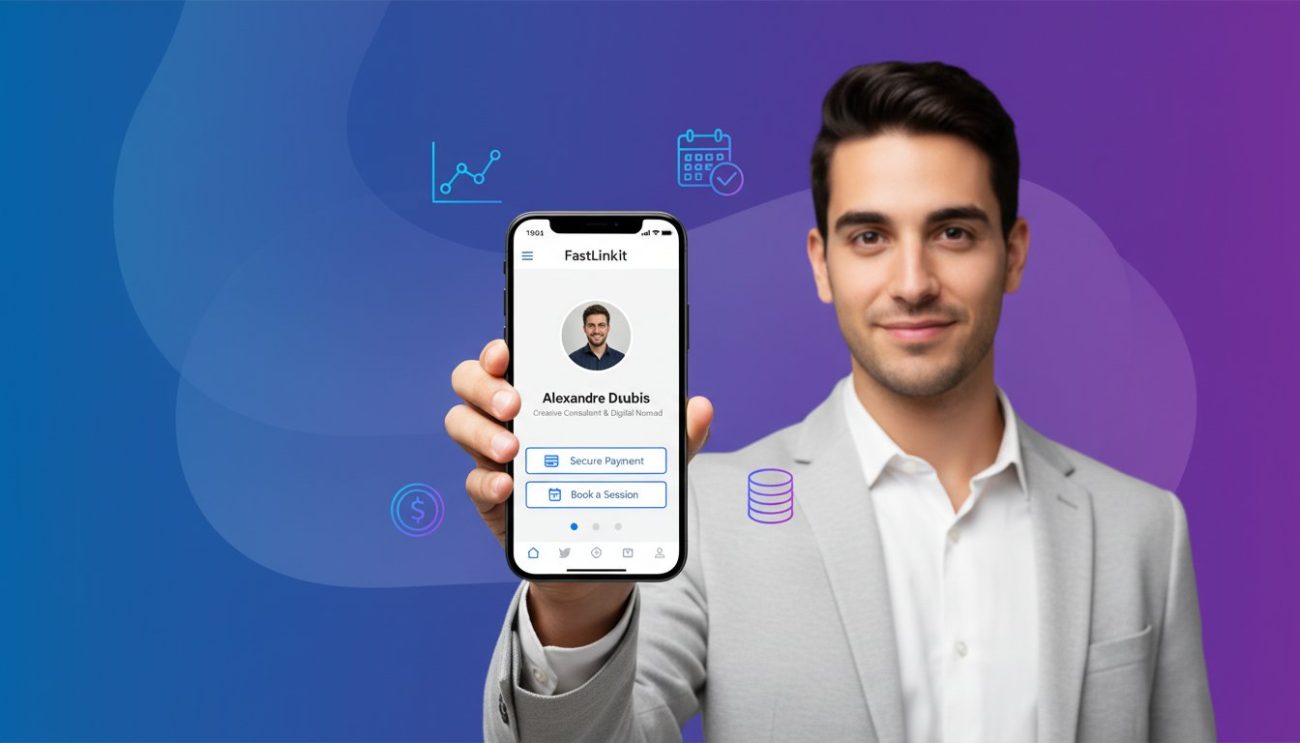
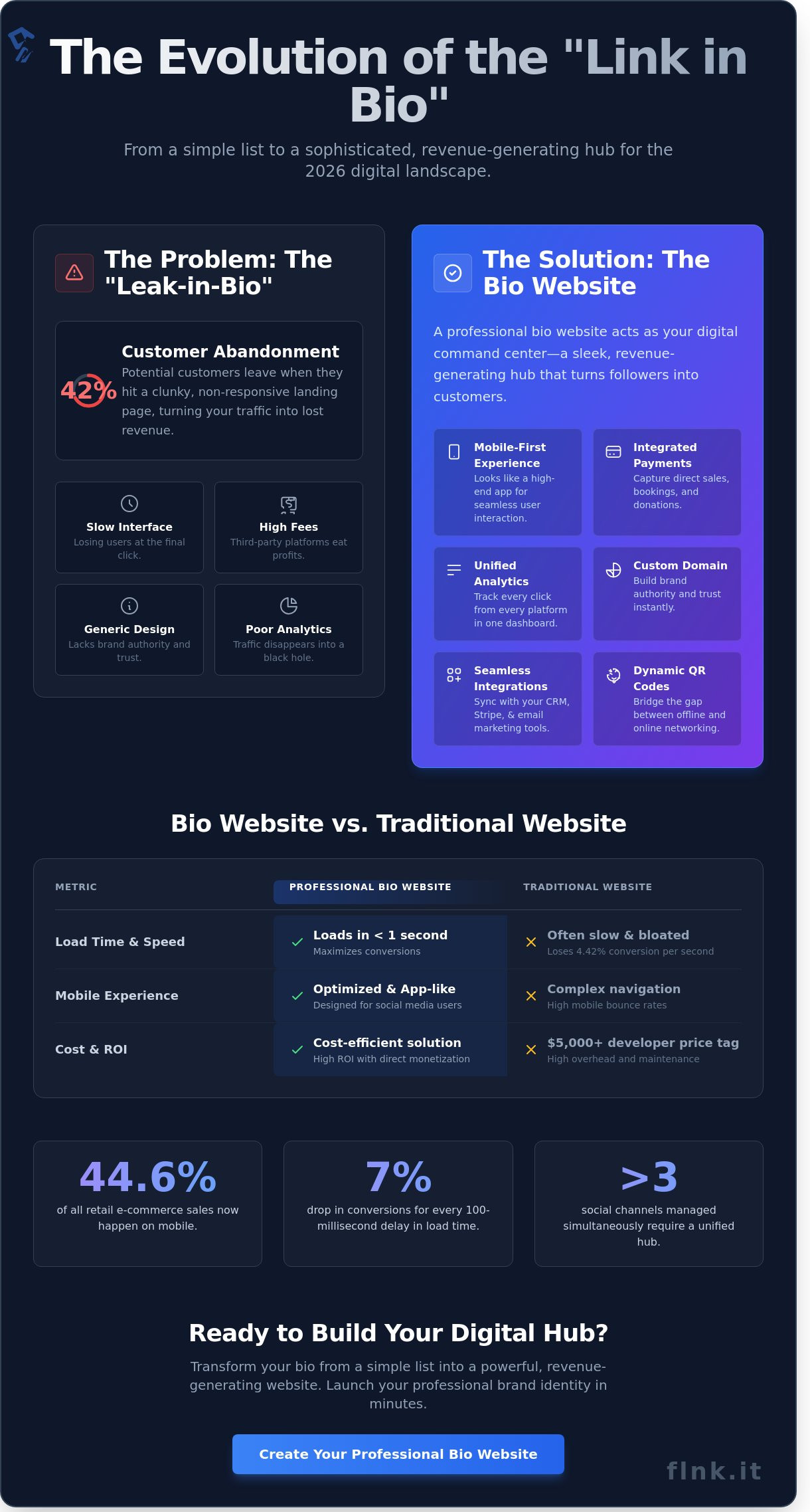
What if your link-in-bio is actually a leak-in-bio? Recent industry reports from 2024 confirm that 42% of potential customers abandon a purchase when they encounter a clunky, non-responsive landing page. You’ve worked hard to build your following. Losing them at the final click because of a slow interface or high third-party fees is a silent revenue killer. A generic list of links simply isn’t enough to compete in the 2026 digital economy.
You already know that social media platforms are designed for scrolling, not for closing deals. It’s exhausting to manage multiple platforms only to see your traffic disappear into a black hole of poor analytics. This guide transforms that frustration into a competitive advantage. You’ll learn how to build a professional bio website that serves as a sleek, revenue-generating hub for your brand. We’ll show you how to eliminate high overheads and capture direct payments without the usual technical headaches.
We’re breaking down the exact process to create a mobile-first experience that looks like a high-end app but functions like a powerhouse sales team. From choosing minimalist layouts to mastering unified traffic data, you’re about to turn one tap into a lasting business connection.
Key Takeaways
- Transition from a simple link list to a sophisticated, integrated business hub built for the 2026 digital landscape.
- Identify the essential features of a high-converting bio website, from mobile responsiveness to seamless CRM and payment integrations.
- Follow a precision-focused, step-by-step guide to secure your custom domain and launch a professional brand identity in minutes.
- Unlock immediate revenue streams by integrating one-click payments, bookings, and donation tools directly into your profile.
- Bridge the gap between offline and online networking using dynamic QR codes and advanced analytics to track your growth.
What is a Bio Website and Why Does Your Brand Need One in 2026?
A bio website is your digital command center. It’s a single, mobile-optimized hub that aggregates every digital touchpoint into one clean URL. In 2026, the “link in bio” has evolved far beyond a simple list of buttons. It’s now a high-performance micro-site designed for immediate interaction. This tool acts as your digital headquarters; it’s where your Instagram followers, TikTok viewers, and YouTube subscribers meet to take the next step in their journey with you.
The shift from basic lists to integrated business tools is driven by necessity. Digital clutter is at an all-time high. Recent data shows that mobile commerce now accounts for 44.6% of all retail e-commerce sales. Users don’t have the patience to navigate traditional, multi-page sites on a smartphone. They want speed. They want simplicity. They want everything in one place. While early pioneers like Linktree introduced the concept of link sharing, 2026 demands a more professional, integrated approach to bio website management.
Cross-platform marketing is no longer optional. You’re likely managing three or more social channels simultaneously. A bio website unifies this fragmented traffic. It eliminates the “where do I find that?” question by providing a consistent destination. It’s about moving from passive browsing to active conversion in a single touch. To understand the full strategic potential of this approach, explore our comprehensive guide to the strategic link in bio for 2026 and discover how to turn your profile into a high-converting digital storefront.
Bio Website vs. Traditional Website
Traditional websites are often bloated and slow. They struggle with high bounce rates on mobile devices because of complex navigation. A bio website focuses on speed and simplicity. It loads in under one second, which is critical since conversion rates drop by 4.42% for every additional second of load time. By eliminating navigation friction, you drive direct sales and sign-ups. It’s a cost-efficient solution that provides a high-end presence without the $5,000 developer price tag. It’s about efficiency, not excess.
Key Benefits for Creators and Small Businesses
Data is the currency of 2026. A bio website allows you to track every click from every platform in one centralized dashboard. You’ll know exactly which TikTok video drove the most sales or which Instagram Story triggered the most bookings. This precision allows for smarter marketing spend.
- Professionalism: Use custom domains to build brand authority and trust instantly.
- Scalability: You can add features like integrated payments or event bookings as your business grows.
- Sustainability: Digital profiles replace thousands of paper business cards, aligning your brand with modern environmental values.
Your digital profile is more than a link; it’s a status symbol. It shows you’re a step ahead of the trends. It’s about providing a seamless, app-free experience that respects your audience’s time and attention.
How to Choose the Best Bio Website Builder for Your Needs
Your bio website acts as your digital headquarters. It’s the primary touchpoint for your audience, so the platform you choose defines your conversion potential. Speed is the first metric that matters. According to research by Akamai, a 100-millisecond delay in load time can drop conversion rates by 7%. You need a builder that prioritizes mobile-first architecture. Most visitors will access your profile through social apps on their smartphones. If the page lags or the layout breaks, you’ve lost them.
Customization should go beyond picking a background color. Look for granular control over typography and button styles. Your digital presence must feel like an extension of your brand, not a generic template. Beyond aesthetics, connectivity is vital. A professional builder doesn’t work in isolation. It should sync effortlessly with your CRM, Stripe, or email marketing tools. Native integrations eliminate the need for messy third-party workarounds, keeping your data clean and actionable.
Don’t fall for the “free” trap. Many platforms offer no-cost tiers that come with a heavy psychological price. Mandatory “Powered by” banners scream amateurism and distract from your call to action. These plans also gatekeep essential data. If you can’t see which specific link drove a conversion, you can’t optimize your strategy. In the 2026 digital economy, data is your most valuable asset. Investing in a premium tool ensures you own your audience insights without platform interference. Before committing to a paid plan, explore our roundup of the best free link in bio tools for 2026 to benchmark what conversion-focused features are available at no cost.
The “Must-Have” Feature Checklist
- Dynamic QR codes: These are essential for offline-to-online conversion. They allow you to update your destination URL without printing new materials.
- Built-in payment tools: You should be able to collect payments or donations directly on your profile to reduce friction.
- Advanced analytics: Move beyond simple click counts. You need to see referral sources, geographic data, and device types to understand your reach.
Agency and Professional Features
Agencies managing multiple creators or brands need specific workflows. Multi-account management is a baseline requirement. It lets you toggle between different profiles without the friction of multiple logins. For those who demand total brand alignment, custom CSS is a game changer. It allows you to bypass template limitations for a truly unique look. Finally, API access is no longer optional for high-volume users. It enables automated link management and integrates your bio website directly into your existing business automation. If you’re building for clients, white-labeling is a necessity. Removing the platform’s branding ensures you deliver a polished, professional product that keeps your agency center stage.
Step-by-Step: How to Create a Professional Bio Website in Minutes
Speed is the new digital currency. You don’t need a developer or a week of coding to establish your presence. Follow this streamlined process to build a high-performance bio website that turns scrollers into customers.
- Step 1: Claim your identity. Choose a unique handle or a custom domain. Data shows that branded links receive 34% more clicks than generic strings. Aim for maximum brand recall by keeping it short and identical to your social handles.
- Step 2: Style your interface. Select a high-converting template. Don’t just pick what looks good; pick what works. Customize your colors to match your brand identity. Consistent branding across platforms can increase revenue by 23% according to industry benchmarks.
- Step 3: Apply the “Priority First” method. Organize your links based on your 2026 goals. Place your primary call-to-action at the very top. On a standard bio website, the first link captures approximately 40% of all engagement.
- Step 4: Embed rich media. Don’t just link to content; bring the content to your profile. Add music players, latest YouTube videos, or interactive maps. Engagement rates spike by 2x when users can consume media without leaving your page.
- Step 5: Launch and sync. Once your profile is live, integrate your URL across every touchpoint. Use flnk.it to manage your digital presence and ensure your “front door” is always open.
Designing for Mobile-First Conversion
Mobile devices account for 92.3% of internet traffic. Use the “Thumb Zone” rule by placing your most critical buttons in the center-bottom of the screen where they’re easiest to reach. Create a clear visual hierarchy. Use bold buttons for sales and subtle icons for secondary social links. Learn how to master your social media front door to ensure your mobile layout converts at peak efficiency.
Managing and Shortening Your Links
Cluttered URLs kill trust. You should always use a professional URL shortener to keep your profile clean and trackable. Vanity URLs build immediate authority and tell users exactly where they’re going. The best part is the flexibility. You can update your destinations in real-time. If your promotion changes at midnight, you update one link in your dashboard instead of editing five different social media bios.
Monetizing Your Bio Site: Payments, Donations, and Bookings
Your bio website shouldn’t just be a static list of links; it should be a high-velocity revenue engine. In 2026, friction is the ultimate conversion killer. If your audience has to jump through multiple tabs to pay you or book a session, they’ll drop off. Professional creators and businesses now use their bio profile as a centralized hub to capture value the moment intent is highest. By integrating financial tools directly into your mobile-first landing page, you transform a simple digital business card into a 24/7 storefront.
Accepting Payments and Donations
Modern monetization relies on speed. Integrating Stripe allows you to collect payments and donations with a single click, supporting Apple Pay and Google Pay for instant checkout. This integration is vital because a 2023 study by the Baymard Institute found that 18% of shoppers abandon checkouts due to overly complex processes. Keeping the transaction inside your bio website environment builds trust and keeps the user focused on the value you provide.
For creators and non-profits, transparency drives engagement. You can set up fundraising goals to show your community exactly how their support helps. Visual progress bars create a sense of collective achievement, which often leads to higher average donation amounts compared to “hidden” tip jars. It’s a clean, professional way to fund your next project without the clutter of third-party platforms.
Streamlining Appointments and Events
Time is your most valuable asset. Manually emailing back and forth to find a meeting time is an outdated practice that wastes hours every week. Using an integrated event booking system allows you to sell tickets for workshops or book high-ticket consultations directly from your profile. This automation ensures you’re only working when you want to, while the system handles the logistics.
The real power of an integrated system lies in the follow-up. Automating your confirmation emails and SMS reminders is a proven strategy to protect your revenue. Data from a 2024 Appointy industry report shows that automated reminders can reduce no-shows by up to 41%. When a client books through your bio site, the event should automatically sync with your primary Google or Outlook calendar, ensuring your schedule is always accurate and your time is protected.
- Own your audience: Use email capture forms to build a list you control, rather than relying on shifting social algorithms.
- Security first: Integrated payments mean users never share sensitive data with unverified third parties.
- Instant Sync: Every booking and payment is logged in real-time, giving you a clear view of your business performance.
Stop losing potential revenue to fragmented tools and broken links. It’s time to turn your profile into a professional business platform that works as hard as you do.
Optimizing for Growth: Analytics and Offline Integration
Building your bio website is only the first step toward digital dominance. To truly scale, you must transform your page from a static link list into a high-performance growth engine. Data doesn’t lie. It reveals exactly where your audience comes from and what they do once they arrive. By 2026, the most successful creators will be those who treat their bio site as a laboratory for constant improvement.
Advanced Analytics and Tracking
Stop guessing which platforms work. Use UTM parameters to track the specific origin of every click. When you see that a single LinkedIn post generated 45% of your weekly sales, you know where to double down. High-level tracking goes beyond simple click counts. You need to analyze geographic and device data to understand your audience’s habits. If 80% of your visitors use mobile devices during evening hours, your content strategy should reflect that peak activity.
Setting up pixel tracking is a game-changer for conversion. By integrating a tracking pixel, you can launch retargeting campaigns for people who visited your bio website but didn’t complete a purchase. Industry data from 2025 shows that retargeted visitors are 70% more likely to convert than first-time guests. This technical edge separates professional setups from amateur profiles.
Bridging the Gap with QR Codes
Your digital presence shouldn’t be trapped behind a screen. Use custom QR codes to pull offline customers into your ecosystem instantly. Place these codes on business cards, event posters, or product packaging. It eliminates the friction of manual typing and creates a seamless transition from a physical handshake to a digital follow.
Dynamic QR codes are the gold standard for long-term marketing. Unlike static codes, dynamic versions allow you to update the destination URL without reprinting your physical assets. This flexibility saves costs and prevents broken links in the field. Modern networking is about efficiency and sustainability. Transitioning to a digital-first approach reduces paper waste by 95% compared to traditional networking methods. Create your free bio website and start growing today to experience this streamlined workflow.
Optimization also requires rigorous A/B testing. Small changes lead to massive results. Try testing different button texts like “Join the Club” versus “Sign Up Now.” Data suggests that action-oriented, low-friction language can improve click-through rates by up to 18%. Once you master these micro-conversions, your bio website becomes the foundation of a massive digital ecosystem that works for you 24/7.
Your Future Identity Starts Today
The digital landscape of 2026 demands more than a static link. Your online presence needs to be a conversion engine. By centralizing your brand, you eliminate friction and capture leads instantly. Thousands of creators already use these tools to replace outdated paper business cards. A well-optimized bio website isn’t just a trend; it’s your new professional headquarters. You’ve learned how to launch a profile in under 5 minutes using no-code drag-and-drop technology. Integration with Stripe and PayPal allows you to process payments or bookings without leaving your page. This efficiency is why 85% of modern entrepreneurs are moving toward all-in-one digital profiles.
Stop losing traffic to fragmented platforms. Join over 12,000 global professionals who have already transitioned to the future of networking. Build your brand on a foundation of speed and elegance. It’s time to turn your social traffic into a sustainable business. Create Your High-Converting Bio Website Now. Your brand deserves a home that works as hard as you do.
Frequently Asked Questions
Is a bio website better than a traditional website for social media?
A bio website is significantly better for social media because it’s optimized for the 91% of users who access platforms via mobile devices. While traditional sites often suffer from high bounce rates due to complex navigation, these streamlined pages provide a focused, single-column experience. This minimalist approach reduces decision fatigue and can increase your total click-through rates by up to 28% compared to standard homepages.
Can I use my own domain name with a bio website?
You can absolutely use your own domain name to maintain a professional brand image. Connecting a custom URL like yourname.com or brand.link reinforces your digital identity and improves brand recall instantly. Modern platforms offer simple DNS integration that takes less than 5 minutes to set up, ensuring your profile looks like a bespoke destination rather than a generic sub-domain.
How do I accept payments on my bio website without a complicated setup?
Accepting payments is simple through direct integrations with secure providers like Stripe or PayPal. You don’t need a complex e-commerce backend or a shopping cart to sell digital products, services, or collect tips. Most high-converting profiles use “Buy Now” buttons or embedded checkout widgets that process transactions in a single click, keeping the user engaged without forcing them to leave your page.
Do I need to know how to code to build a bio website?
You don’t need to know a single line of code to build a stunning bio website in 2026. These platforms utilize intuitive drag-and-drop interfaces and pre-designed modules that handle all the technical heavy lifting for you. You focus on your content and branding while the system automatically ensures your site is responsive, fast, and secure across every modern mobile browser.
Can I track how many people click on each link in my bio?
Real-time link tracking is a standard feature that lets you see exactly how many people click every element on your page. You’ll get detailed insights into geographic locations, device types, and referral sources through a clean analytics dashboard. According to 2025 industry benchmarks, creators who analyze these metrics weekly see a 15% improvement in their conversion rates by optimizing their link placement.
Is it possible to manage multiple bio websites from one account?
Managing multiple profiles from a single dashboard is a core feature for agencies and multi-hyphenate entrepreneurs. You can switch between different brands or personal projects with one login, maintaining separate analytics and custom domains for each profile. This centralized control eliminates the friction of logging in and out of different accounts, saving you hours of administrative work every month.
How much does it cost to maintain a professional bio website in 2026?
Maintaining a professional profile typically involves a monthly subscription and an annual domain renewal fee. According to Namecheap’s 2024 pricing reports, a standard .com domain costs roughly $10 to $15 per year. Platform fees vary based on your required features, but the total cost of ownership remains significantly lower than hosting and maintaining a traditional multi-page WordPress site or custom-coded solution. If you’re budget-conscious, reviewing the top free link in bio tools available in 2026 can help you identify which platforms deliver professional-grade features before you invest in a paid tier.
Can I add a contact form or email signup to my bio page?
You can easily add contact forms and email signup blocks to capture leads directly from your mobile traffic. Most platforms integrate natively with Mailchimp, ConvertKit, or Google Sheets to automate your lead management workflow. This turns your social media presence into a sustainable email list, which HubSpot research shows still delivers a 3,600% ROI for digital marketers and small businesses.