
Your payment processor is likely your most expensive unmanaged vendor. Industry reports from late 2025 show that lean businesses lose up to 3.5% of their gross revenue to inefficient payment rails and hidden markups. You’ve probably stared at opaque monthly statements with frustration. Surprise chargeback fees and high international costs eat into your margins before you even see the profit. It’s time to avoid high payment processing fees through strategic orchestration rather than just hoping for better rates.
You want a lower effective processing rate and a workflow that doesn’t require a degree in finance to understand. Analyze your data. Choose your rails. Keep your profit. We’ll show you how to identify hidden costs and leverage the right technology to keep your revenue. This guide previews the shift toward ACH optimization and explains how to choose the right payment rail for every customer in 2026. You’ll gain a clear roadmap to stop the profit leak and build a more sustainable, tech-forward financial operation. Let’s modernize your bottom line.
Key Takeaways
- Shift high-value invoices to ACH or bank transfers to swap expensive percentages for predictable flat-rate caps.
- Audit your statements to distinguish between non-negotiable interchange rates and the hidden markups added by your processor.
- Discover how to legally implement convenience fees and strategic workflows to avoid high payment processing fees in 2026.
- Leverage dynamic QR codes and consolidated payment dashboards to reduce checkout friction while lowering your effective processing rate.
Beyond the Percentage: Why High Payment Fees Are Stalling Your 2026 Growth
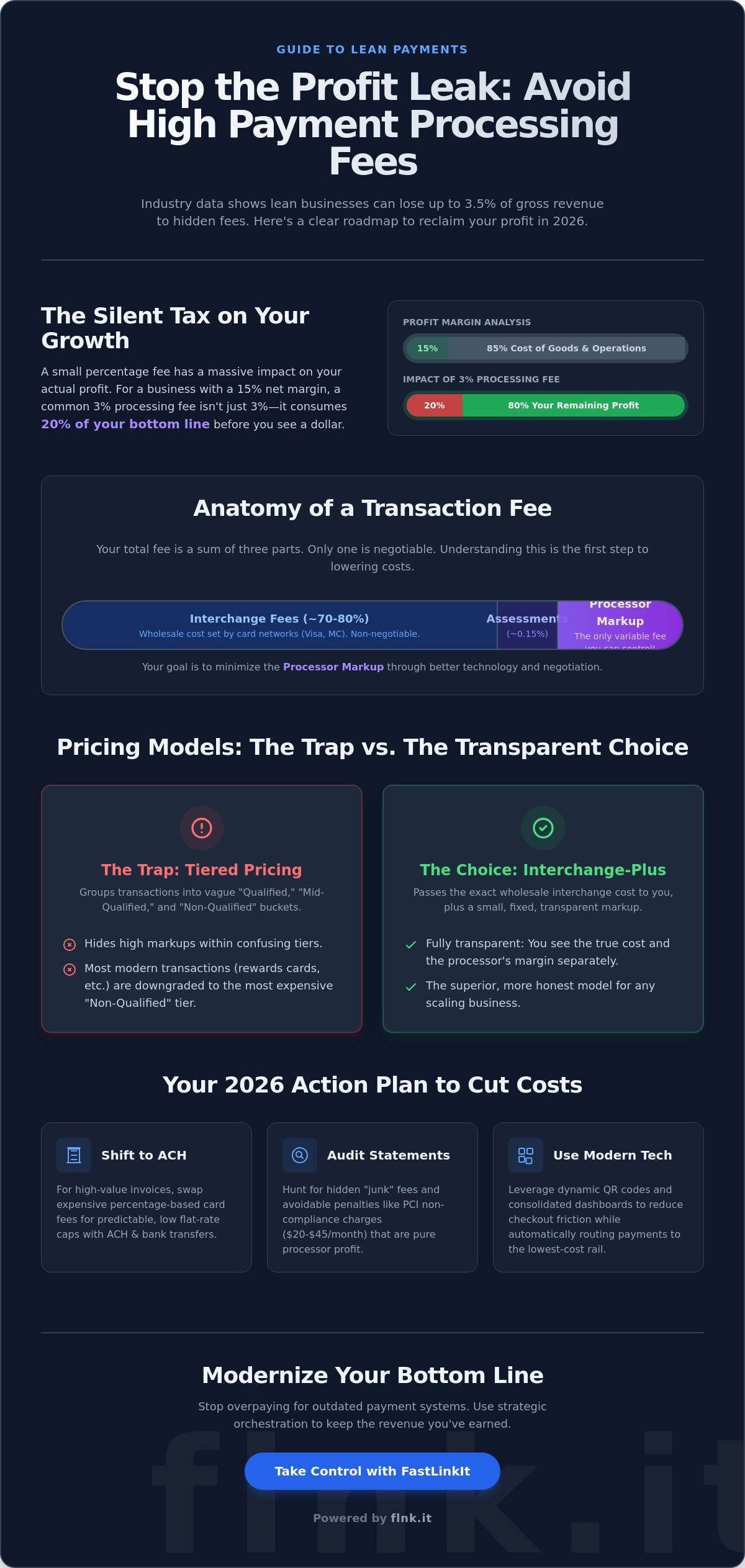
A 3% transaction fee sounds small. It’s not. If your business operates on a 15% net margin, that processing fee consumes 20% of your actual profit. This is the silent tax that stalls growth for lean businesses in 2026. You aren’t just paying for a transaction; you’re subsidizing a legacy system that hasn’t modernized as fast as your business has. To avoid high payment processing fees, you must look at the net impact on your bottom line, not just the top-line percentage.
By mid-2026, traditional credit card rails have become the premium, high-cost option. Newer alternatives are faster and significantly cheaper. Flat-rate pricing models, while simple, often hide significant markups for low-risk merchants. They charge you a premium for the convenience of not understanding your statement. If you primarily process domestic, low-risk transactions, you’re likely overpaying by 0.7% to 1.2% compared to an interchange-plus model. This creates a psychological barrier. You stop pushing $10 products because the 30-cent fixed fee makes the margin too thin. Scaling becomes a math problem you can’t win.
The Hidden Costs of Traditional Processing
Visible fees are just the tip of the iceberg. Many processors bury “junk” monthly service fees or PCI non-compliance penalties in the fine print. A standard Interchange fee is set by the card networks, but everything on top of that is the processor’s margin. PCI non-compliance fees often range from $20 to $45 per month. They’re entirely avoidable. Most processors won’t tell you how to stop them because they’re pure profit. International sales add another layer of complexity. Currency conversion markups can reach 2% above the mid-market rate, quietly siphoning off your international growth.
Why 2026 is the Year of Payment Transparency
Open banking has finally matured. It allows customers to pay directly from their bank accounts, bypassing card networks entirely. This shift is essential if you want to avoid high payment processing fees on high-value invoices. AI tools now help merchants predict chargeback risks before they happen. These tools analyze transaction patterns in real-time to flag payments that might trigger a $25 dispute fee. Payment orchestration is the automated routing of transactions to the lowest-cost provider. Using modern tools like Flnk’s payment features helps you stay lean and agile. You get the technology of a global enterprise with the simplicity of a single touch.
Decoding the Statement: Interchange, Assessments, and Processor Markups
Your merchant statement shouldn’t look like a secret code. Most processors rely on your confusion to maintain their margins. To avoid high payment processing fees, you need to strip the statement down to its three core components: interchange, assessments, and markups. Think of it as the anatomy of a transaction.
Interchange fees represent the wholesale cost of the transaction. Card networks like Visa and Mastercard set these rates based on risk, card type, and industry. They’re non-negotiable. Assessment fees are even smaller, paid directly to the networks for brand maintenance. According to this Forbes guide to processing fees, these base costs are standard across the industry. The processor markup is the only variable. This is where your provider adds their profit margin; it’s the only part you can actually negotiate or eliminate through a better workflow.
If you run an e-commerce store or a remote service, you’re likely dealing with Card-Not-Present (CNP) status. This classification automatically inflates your base interchange rate because the risk of fraud is higher. You can’t change the status, but you can change how you process the data to minimize the markup. Every bit of data you collect during checkout helps lower the perceived risk and keep your rates as lean as possible.
Understanding Interchange-Plus vs. Tiered Pricing
Tiered pricing is a common trap for lean businesses. Processors group transactions into “Qualified,” “Mid-Qualified,” and “Non-Qualified” buckets. It sounds simple. It’s actually a way to hide high markups. A “Qualified” rate might look low, but most modern transactions, like rewards cards, will be downgraded to “Non-Qualified” with much higher fees. Interchange-plus pricing is the superior choice for growth. It shows you the exact interchange cost plus a flat, transparent markup. To find your truth, calculate your effective rate: divide your total monthly fees by your total processing volume. If that number is north of 3.5% in 2026, you’re overpaying.
The Impact of Card Types on Your Bottom Line
Not all plastic is equal. Debit cards carry significantly lower interchange rates because the funds are guaranteed by a bank account. Credit cards, especially premium rewards or corporate cards, are a different story. A premium rewards card can cost a merchant 2x more in fees than a standard debit card. Your interface should encourage debit usage or bank transfers whenever possible. Modern tools like Flnk’s payment solutions allow you to present the most cost-effective options to your customers with a single tap. This subtle shift in user experience can save you thousands in annual processing costs while keeping your brand image sharp and professional.
5 Proven Strategies to Avoid High Payment Processing Fees Today
Efficiency is a choice. In 2026, lean businesses don’t just accept the rates they’re given; they engineer their workflows to protect their margins. To avoid high payment processing fees, you must move beyond passive acceptance and start directing your customers toward the most cost-effective payment rails. This isn’t about cutting corners. It’s about using technology to bypass the “silent tax” of legacy finance.
Start by auditing your invoice volume. Transitioning high-value transactions to ACH or bank transfers replaces expensive percentages with predictable flat-rate caps. Beyond that, you can legally implement “Convenience Fees” or “Cash Discounts” to pass processing costs to the consumer. For B2B companies, optimizing for Level 2 and Level 3 data processing is a game-changer. By providing more transaction data like tax IDs and zip codes, you lower the risk profile of the payment, which triggers lower interchange rates from the card networks. Always use Address Verification Service (AVS) and CVV checks. These security layers don’t just stop fraud; they prevent the “risk-based” fee hikes that processors apply to unverified transactions. Finally, consolidate your tech stack. Using multiple gateways and platforms creates layers of unnecessary fees. A single, integrated dashboard is your best defense against margin erosion.
Strategy 1: Leveraging ACH and Open Banking
ACH is the most effective tool for recurring subscriptions or donations over $100. While a 3% card fee on a $500 payment costs you $15, an ACH transfer typically costs less than a dollar. It’s a massive difference for your net profit. You can use Flnk’s payment features to offer these multiple paths without adding friction to the user experience. If you’re ready to modernize your collection process, check out this guide on how to easily collect payments and donations online in 2026. It provides the exact roadmap for setting up low-fee bank transfers alongside your standard options.
Strategy 2: Reducing Chargebacks and Fraud Fees
The hidden “Chargeback Fee” is a profit killer. One single dispute can cost you between $20 and $50 in administrative fees, regardless of whether you win the case. You also lose the revenue and the product. Modern security protocols like 3D Secure 2.0 are essential. They shift the liability back to the card issuer and lower your overall risk profile with your processor. Clear branding also plays a role. Using a professional “Link-in-Bio” page ensures customers recognize your brand on their statement, which significantly reduces “unrecognized merchant” disputes. When your digital presence is cohesive, you avoid high payment processing fees triggered by preventable customer confusion.
Reducing Friction and Fees: How Your Payment Interface Impacts the Bottom Line
A complex checkout is a financial leak. By January 2026, data suggests that mobile cart abandonment rates still hover near 70% when users face more than three form fields. You might be obsessed with a 0.5% fee reduction, but if your interface causes a customer to leave, you lose 100% of that revenue. The cost of friction is always higher than the cost of processing. To avoid high payment processing fees, you must first ensure your interface is efficient enough to capture the sale in the first place.
Modern creators and lean entrepreneurs are shifting toward Link-in-Bio pages as their primary storefronts. These minimalist interfaces are the most efficient way to collect payments because they strip away the bloat of traditional e-commerce sites. FastLinkIt integrates seamlessly with Stripe to provide a secure, low-friction payment experience that customers trust. One-click payments are the gold standard here. They balance the need for a fast user experience with the technical requirements of secure processing. When the path to purchase is a single touch, your conversion rate climbs, effectively lowering your cost per acquisition.
Optimizing the Bio-Link Checkout
Professionalism reduces risk. You can use flnk.it/features/payments to create a dedicated, branded payment portal that looks and feels like part of your brand. Raw, unbranded payment links are frequently flagged by modern banking algorithms as potential phishing attempts. A branded portal provides the social proof needed to clear these hurdles. For those focused on social impact or community support, integrating flnk.it/features/payments#fundraising offers a streamlined way to collect donations. This approach bypasses the heavy 5% to 10% platform fees charged by traditional fundraising sites, keeping more money in your mission.
Mobile Wallets: Apple Pay and Google Pay
There’s a persistent myth that mobile wallets add extra “wallet fees” to every transaction. This is incorrect. Apple Pay and Google Pay typically use the same interchange rates as the card stored within the wallet. Biometric authentication, such as FaceID or TouchID, actually helps you avoid high payment processing fees by reducing the “Risk Premium” charged by some processors. These security measures provide stronger proof of identity than a manually entered CVV code. Mobile-first payment links are essential for the 2026 consumer who expects to pay in seconds without reaching for a physical wallet. Ready to streamline your revenue? Optimize your payment interface with Flnk today.
Scaling Without the Surcharge: The FastLinkIt Approach to Lean Payments
Growth is a double-edged sword when your tech stack takes a percentage of every new dollar. Many traditional platforms charge a “platform fee” on top of your processor’s rate. This is a surcharge on your success. To avoid high payment processing fees, you must consolidate your marketing and financial workflows into a single, efficient dashboard. By eliminating the middleman platforms that stack their own margins on top of Stripe’s rates, you keep your margins intact as you scale.
Flnk provides a unified ecosystem where link shortening, dynamic QR codes, and payment collection live together. This isn’t just about convenience; it’s about financial precision. Dynamic QR codes are the 2026 standard for offline-to-online transitions. They allow you to collect payments at events or physical locations without the need for expensive hardware or high-fee POS systems. You also save on administrative overhead by managing contacts and email marketing within the same environment. A flat-fee SaaS model is always more predictable than a “percentage-of-everything” model. It allows you to forecast your costs with 100% accuracy, regardless of your monthly volume.
The FastLinkIt Ecosystem
Modern businesses need specialized tools that don’t carry specialized price tags. You can manage paid events using Flnk’s event booking features. This allows you to bypass the heavy third-party platform fees that often consume 10% of ticket revenue. If you’re a developer or creator, you can use Flnk to sell code or digital assets directly to your audience. This direct-to-consumer approach is the most effective way to avoid high payment processing fees while maintaining total control over your digital products. For a deeper look at how to position your brand for maximum efficiency, read The Strategic Link in Bio: A Comprehensive Guide for 2026.
Next Steps: Your Fee Reduction Checklist
Efficiency requires regular maintenance. Start by auditing your merchant statements from the last 90 days. Look specifically for “miscellaneous” or “service” fees that don’t correlate to transaction volume. These are often negotiable or entirely removable. Next, verify your Merchant Category Code (MCC). If your business is misclassified, you might be stuck in a “high-risk” tier with inflated interchange rates. A simple correction can lower your base costs instantly. Finally, sign up for Flnk to streamline your payment links. It’s the fastest way to reduce administrative friction and protect your revenue in a competitive market. Modernize your workflow. Protect your profit. Start today.
Future-Proof Your Revenue Stream
Efficiency is the ultimate competitive advantage for lean businesses in 2026. You’ve learned that profit protection isn’t just about finding the lowest rate; it’s about strategic payment orchestration. By auditing your merchant statements for hidden markups and shifting high-value transactions to ACH rails, you can effectively avoid high payment processing fees. Your interface shouldn’t just look good. It needs to convert fast and minimize risk-based surcharges through biometric authentication and branded portals that build trust instantly.
Stop letting legacy systems siphon off your hard-earned revenue. FastLinkIt provides the modern tools you need to scale without the surcharge. With direct Stripe integration, dynamic QR code payment collection, and an all-in-one marketing and payment suite, you can manage your entire financial workflow from a single, minimalist dashboard. It’s time to build a leaner, more profitable business that prioritizes sustainability and growth. Stop overpaying and start collecting payments smarter with FastLinkIt. The future of payments is one touch away. You’re ready to lead the way and keep more of what you earn.
Frequently Asked Questions
What is the average credit card processing fee for small businesses in 2026?
Small businesses in early 2026 typically see average credit card processing fees between 2.5% and 3.5% for online transactions. These rates fluctuate based on the card network and the merchant’s risk profile. While some flat-rate providers offer 2.9%, businesses processing over $100,000 annually often negotiate lower interchange-plus rates. Monitoring these numbers monthly is the first step to keeping your margins healthy.
Can I legally pass credit card processing fees to my customers?
Yes, you can legally pass these costs to customers in 48 US states; you just need to follow specific disclosure rules. Many businesses prefer “Cash Discount” programs over “Surcharging” because they’re easier to manage under 2026 regulations. You must display clear signage at the point of sale or on your digital checkout page to remain compliant. This strategy shifts the cost burden away from your net profit instantly.
How does ACH compare to credit card fees for online donations?
ACH transfers are far more cost-effective than credit cards for donations exceeding $100. While a credit card might take 2.9% of a $1,000 donation, an ACH transfer often costs a flat fee of $1.00 or less. This represents a 96% reduction in fees for that single transaction. Using a unified dashboard helps you offer both options so donors can choose the most efficient path for their contribution.
What are Level 2 and Level 3 processing fees and do I qualify?
Level 2 and Level 3 processing are data-rich transaction tiers that qualify B2B merchants for lower interchange rates. By providing extra information like tax IDs and freight codes, you can reduce your processing costs by up to 1.1% per transaction. Most corporate and government cards require this data to process at the lowest possible rate. Check with your provider to see if your merchant category code (MCC) allows for these optimizations.
Is there a way to avoid fees on international payments?
You can minimize international fees by using multi-currency settlement accounts or local payment methods. Cross-border fees usually add an extra 1.5% to 2% markup on every transaction. By using a modern payment interface that supports local rails, you avoid these expensive conversion markups. This ensures your international growth isn’t stalled by hidden currency exchange costs that eat into your global margins.
Does using a link-in-bio tool like FastLinkIt add extra transaction fees?
No, using FastLinkIt doesn’t add extra transaction fees. It’s designed to help you avoid high payment processing fees by eliminating the middleman platforms that often take a 2% to 5% cut of your sales. You connect your own Stripe account directly, paying only their standard processing rates and your flat Flnk subscription. This ensures your costs remain predictable and transparent as you scale.
What is a chargeback fee and how can I prevent it?
A chargeback fee is a penalty, often ranging from $20 to $50, levied by the acquiring bank when a customer disputes a transaction. You lose the fee regardless of the dispute outcome. To prevent these, use clear billing descriptors and professional payment links that customers recognize. Implementing 3D Secure 2.0 can also reduce your liability for fraudulent disputes by up to 80%.
Are flat-rate payment processors like Stripe always the cheapest option?
Flat-rate processors like Stripe are rarely the cheapest option for businesses processing more than $50,000 per month. While they offer simplicity, an interchange-plus pricing model provides more transparency and lower effective rates for high-volume merchants. You should avoid high payment processing fees by periodically comparing your effective rate against wholesale interchange costs. This ensures you’re not paying a premium for a simplicity you no longer need.