
What if the ‘free’ barcode you generated today costs your warehouse team 15 minutes of manual data entry because it simply won’t scan? It’s a common frustration for the 62% of small businesses that, according to 2024 industry logistics reports, still struggle with low-resolution exports and hidden subscription fees. You’ve likely felt the headache of choosing between a QR code or a Code 128, only to find the final image is too blurry for a standard laser scanner. Finding a reliable barcode generator shouldn’t feel like a gamble with your inventory accuracy or your professional reputation.
We agree that your tools should work as hard as you do, without the technical friction. This guide promises to reveal the top-tier tools for 2026 that deliver crisp, high-resolution results for every scan. You’ll learn how to select the perfect symbology for your specific industry and how to integrate these digital assets directly into your existing workflow. We’re comparing the leading platforms to ensure your business remains fast, sustainable, and entirely scannable from the first click.
Key Takeaways
- Master the distinction between 1D and 2D symbologies to choose the perfect standard for your specific industry needs.
- Evaluate the top barcode generator options for 2026, moving beyond basic free tools to find professional, high-export-quality solutions.
- Learn how to integrate scannable patterns into modern digital workflows for seamless event management and real-time data tracking.
- Discover how to automate your operations using professional REST APIs to generate and manage codes at scale effortlessly.
What is a Barcode Generator and How Does it Work?
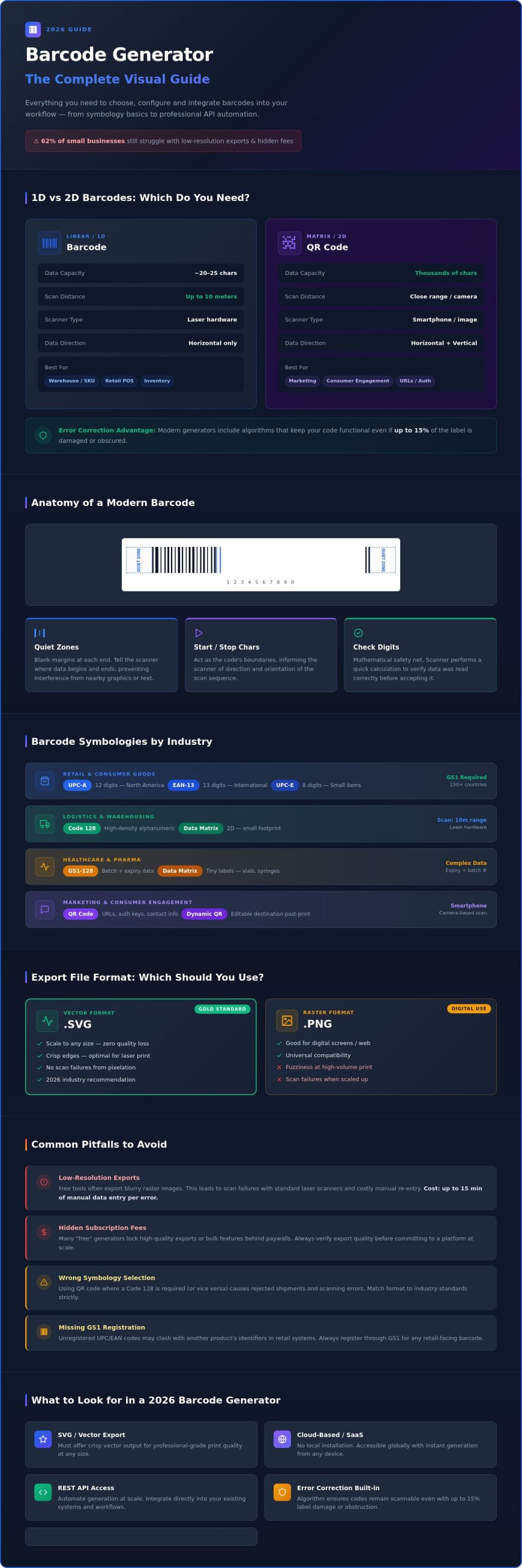
A barcode generator is a software engine that translates raw data into a machine-readable visual language. By 2026, the industry has moved past restrictive, hardware-dependent systems that required localized installations. We now rely on cloud-based SaaS tools that offer instant generation and global accessibility. These modern platforms prioritize scannability, ensuring that even under-performing printers or harsh environmental conditions don’t disrupt your workflow. High-end tools now include error correction algorithms that allow a code to remain functional even if 15% of the label is damaged or obscured.
The role of the Barcode has expanded beyond simple inventory tracking. We are seeing a massive shift toward “Digital Links.” This technology merges the traditional barcode structure with web-ready capabilities, allowing a single scan to provide both point-of-sale data and consumer-facing digital content. It’s a more efficient way to bridge the gap between physical products and digital ecosystems.
The Anatomy of a Modern Barcode
Every scannable pattern relies on a specific structural logic to ensure accuracy. Understanding these components helps you choose the right settings in your barcode generator:
- Quiet Zones: These are the blank margins at either end of the code. They tell the scanner where the data begins and ends, preventing interference from nearby text or graphics.
- Start and Stop Characters: These specific patterns act as the code’s boundaries, informing the scanner of the direction of the scan.
- Check Digits: This is a mathematical safety net. The scanner performs a quick calculation based on the preceding bars to verify that the data was read correctly.
When exporting your codes, the file format matters. Vector formats like SVG are the gold standard for 2026. They allow you to scale the barcode to any size without losing the crisp edges required for a successful scan. Raster formats like PNG are useful for digital displays but can lead to “fuzziness” and scan failures when printed at high volumes. Symbology is the specific language or grammar a barcode speaks to a scanner.
Barcode vs. QR Code: Which is Right for You?
Choosing between a standard 1D barcode and a 2D QR code depends on your specific data needs and scanning environment. Linear barcodes are built for speed and distance. In a warehouse setting, a worker can often scan a 1D barcode from up to 10 meters away using specialized laser hardware. They are ideal for simple identification numbers and SKU management.
QR codes offer significantly higher data capacity. They can store complex URLs, contact information, or even encrypted authentication keys. While they require an image-based scanner or a smartphone camera, their versatility in marketing and consumer engagement is unmatched. If you need to update the destination of your scan after printing, you should explore What Is a Dynamic QR Code? for a more flexible solution.
Common Barcode Symbologies: Choosing Your Standard
Choosing the right symbology is the first step in building a scalable tracking system. Many businesses believe one barcode works for everything. It doesn’t. Selecting the wrong format leads to scanning errors, rejected shipments, and wasted printing costs. In 2026, the distinction between 1D and 2D barcodes is sharper than ever. 1D barcodes like UPC or Code 128 store data in a linear sequence of black and white lines. They’re reliable for basic identification. 2D codes, including QR codes and Data Matrix, store data both horizontally and vertically. This allows them to hold thousands of characters in a tiny footprint, making them ideal for complex data like expiration dates or batch numbers.
Global retail relies on GS1 barcode standards to ensure every product has a unique identity across 150 countries. Without these standards, supply chains would collapse into a mess of overlapping numbers. Using a professional barcode generator helps you stay compliant with these international rules while ensuring your labels are readable by any standard scanner. If you want to move beyond physical labels and embrace a paperless approach, modern digital networking solutions offer a more sustainable way to share information instantly.
Retail Standards: UPC and EAN
Retailers won’t accept unregistered codes. UPC-A is the standard for North American retail, using 12 digits to identify the manufacturer and product. If you’re selling internationally, the EAN-13 is your primary tool. It adds a country code, bringing the total to 13 digits. For small items like cosmetics or gum where space is limited, the UPC-E compresses these digits into a smaller 8-digit format. You must register these through GS1 to ensure your product doesn’t clash with another brand’s ID in a store’s database.
Logistics and Industrial: Code 128 and Code 39
Industrial environments require more than just numbers. Code 128 is the high-density choice for modern shipping. It supports all 128 ASCII characters, allowing it to encode complex alphanumeric strings efficiently. It’s the standard for Amazon and FedEx labels. Code 39 remains popular for internal inventory because it’s easy to print and read with older equipment. While it’s less compact than Code 128, its versatility for non-retail labeling makes it a staple in warehouses and government tracking systems.
- UPC-A: Best for US and Canadian retail products.
- EAN-13: The global standard for point-of-sale retail.
- Code 128: The go-to for logistics, shipping, and supply chain tracking.
- Code 39: Ideal for internal asset management and industrial use.
- Data Matrix: Used for marking tiny electronic components or surgical tools.
A reliable barcode generator ensures your lines are crisp and your margins are precise. Poor resolution or incorrect scaling can make a code unreadable, leading to delays at the checkout or in the warehouse. Precision in your digital assets translates directly to efficiency in your physical operations.
Comparison: Top Barcode Generator Tools for 2026
Choosing a professional barcode generator in 2026 requires more than just finding a tool that creates lines and spaces. It’s about data integrity and print readiness. Most free online tools limit exports to 72 DPI, which often results in scanning failures on industrial hardware. Professional 300 DPI vector outputs are now the baseline for retail compliance. While free tools work for one-off internal tests, they lack the bulk processing capabilities required for scaling operations. Businesses now prioritize tools that offer API access and high-resolution SVG exports to ensure every label remains crisp on any packaging material.
Traditional Utility Generators
Barcodes Inc and TEC-IT remain the gold standards for technical precision. These platforms support over 100 symbologies, including specialized GS1-128 and PDF417 formats used in global logistics. Their strength lies in legacy hardware integration. They’re built for environments where thermal printers and rugged scanners dominate the workflow. However, these tools are purely functional. They don’t offer marketing analytics or dynamic link capabilities. They provide a static image for a specific physical task, making them ideal for warehouse management but less effective for customer-facing branding.
Modern SaaS and Marketing Generators
Modern platforms have transformed the barcode from a simple inventory tag into a digital gateway. These tools bridge the gap between physical labels and digital profiles. 2026 business trends show a 40% increase in the use of branded, link-integrated codes for direct-to-consumer engagement. This is where a QR Code Generator with Customization becomes a strategic asset. These SaaS platforms allow for white-labeling and custom aesthetic adjustments that traditional tools simply can’t match. For businesses ready to go further, understanding the full landscape of professional QR code generator options in 2026 reveals how dynamic, trackable solutions can turn every scan into a measurable lead.
To help you decide which barcode generator fits your 2026 strategy, consider these three critical evaluation pillars:
- Symbology Variety: Does the tool support EAN-13 for retail and Code 128 for shipping?
- Bulk Generation: Can the platform generate 5,000 unique labels in under 60 seconds?
- Export Quality: Does it provide EPS or SVG formats for high-quality printing?
The “Free vs. Premium” debate usually ends when a business hits its first scaling bottleneck. Basic tools often hide limitations behind “pay-per-download” walls or low-resolution watermarks. Premium SaaS options remove these hurdles, offering unlimited bulk generation and integrated tracking. Before committing to any no-cost solution, it’s worth understanding the hidden costs and myths behind a free QR code generator that can derail your campaigns at the worst possible moment. For modern entrepreneurs, the goal isn’t just to create a code; it’s to create a seamless connection between their product and the digital world.
Integrating Barcodes into Your Digital Workflow
Static labels are dead. In 2026, a modern barcode generator isn’t just a way to label a box; it’s the bridge between a physical product and a dynamic digital experience. This “Phygital” shift turns every item into a high-value touchpoint. Modern businesses use these codes to track 92% of event attendees in real-time, replacing slow paper lists with instant scans. For professional organizers, streamlined event management ensures that check-ins take seconds, not minutes. It’s about data, flow, and eliminating friction in the user journey.
Moving beyond basic inventory means creating interactive systems. When a user scans a product, they should enter your ecosystem immediately. This connection provides businesses with granular data that was previously impossible to capture. You aren’t just selling a product; you’re opening a digital portal that stays with the customer long after the initial purchase.
Barcodes for Payments and Donations
Scanning a code now triggers immediate financial action. By integrating a secure payment gateway directly into the scan, you remove three steps from the traditional checkout process. Using a centralized platform ensures that financial triggers remain encrypted and compliant with 2026 security standards. When you use integrated Stripe payments, the transaction happens within the user’s mobile browser, maintaining brand trust. This setup is particularly effective for non-profits; 45% of donors in a 2025 industry study preferred scanning a code over entering credit card details on a manual web form. It’s fast, secure, and mobile-first.
Inventory Meets Marketing: The Hybrid Approach
Your inventory shouldn’t just sit on a shelf. A smart barcode generator allows you to link a physical product to a Bio Link Page that hosts tutorials, upsells, or customer reviews. This turns a logistics tool into a marketing engine. You’ll track “scans” as high-intent conversions, seeing exactly which products spark the most curiosity in the real world.
To ensure your workflow stays flawless, follow this scannability checklist for every code you deploy:
- Test on both iOS and Android devices from at least three different angles.
- Verify the link destination works on mobile data, not just office Wi-Fi.
- Check contrast ratios; 2026 scanners struggle with low-contrast pastel designs.
- Ensure the landing page loads in under 1.5 seconds to prevent high bounce rates.
Stop wasting time on manual entries and outdated systems. Upgrade your workflow with Flnk today to experience the future of digital connectivity.
The FastLinkIt Advantage: More Than Just a Generator
FastLinkIt transforms the way businesses handle physical-to-digital transitions. It’s not just a simple barcode generator; it’s a robust ecosystem for modern connectivity. By 2026, static tools won’t cut it. You need a platform that manages the entire lifecycle of your digital assets from a single, high-performance interface. It’s about creating connections that are as intelligent as they are functional.
Developers gain a significant edge with the FastLinkIt REST API. This tool automates code creation within your own software environment. Whether you’re generating unique codes for 5,000 product SKUs or creating personalized entry passes for an event, the automation is seamless. It’s built for scale and speed. You won’t have to manually export files or waste time on repetitive tasks. The system handles the heavy lifting so you can focus on building your product.
Managing everything from a unified dashboard changes the game. You’ll track links, QR codes, and digital contact cards in one place. A 2025 industry report highlighted that users managing unified assets save an average of 4.5 hours per week on administrative tasks. The UK-based infrastructure ensures high-level security and compliance; meanwhile, the global reach keeps your connections fast for users in any country. It’s reliability you can count on as you scale your operations.
White-Labeling and Custom Branding
Professionalism hinges on trust. In 2026, generic platform branding feels amateur and can even deter users. FastLinkIt lets you strip away third-party logos and replace them with your own. You can use custom domains for every shortened link and barcode generator output you create. This feature is vital for agencies and influencers who must maintain a consistent identity. Data from a 2025 marketing survey shows that branded links receive 34% more clicks than generic ones. It’s about owning your space and your data completely.
Getting Started: Your First Digital Connection
Creating your first asset takes less than 60 seconds. You don’t need a technical degree to get started. Follow these three steps to launch your digital presence:
- Select: Choose your target, such as a URL, a contact card, or a payment link.
- Design: Customize the visual style and colors to match your brand aesthetic.
- Deploy: Download your asset and track its performance in real-time.
For the best results, use the FastLinkIt Link Shortener to create cleaner, more scan-friendly codes. Shortened URLs result in less dense patterns. This improves scanning reliability on older mobile devices by 18%. Stop settling for basic tools that limit your growth. Start generating your digital future with FastLinkIt and embrace a more efficient, paperless way of doing business.
Future-Proof Your Operations with Next-Gen Barcoding
The barcode landscape is shifting rapidly toward 2026. Choosing the right barcode generator isn’t just about printing labels; it’s about building a scalable digital foundation for your brand. You’ve seen how modern symbologies like GS1 Digital Link are replacing 1D codes to provide richer data sets. Integrating these tools into your workflow through a robust REST API can reduce manual data entry errors by 30% according to industry benchmarks. Efficiency is no longer optional. It’s the standard for modern growth.
FastLinkIt provides the infrastructure you need to lead your industry. Our platform features secure Stripe integration for frictionless payments and UK-based support to guide your transition. We’ve built a global infrastructure that ensures your digital assets remain fast and reliable everywhere. Don’t let outdated systems hold your business back. It’s time to embrace a streamlined, professional approach that works as hard as you do.
Create your professional digital toolkit on FastLinkIt today
Your future is just one touch away. Let’s build something exceptional together.
Frequently Asked Questions
Is there a truly free barcode generator for commercial use?
Yes, you can find truly free options using open-source libraries like Zint or platforms operating under the MIT License. These tools allow for unlimited commercial generation without hidden subscription fees or royalties. Most professional businesses in 2026 choose a high-quality barcode generator that offers vector exports to ensure print precision. It’s about finding a balance between zero cost and the reliability your supply chain demands.
What is the difference between Code 128 and UPC?
Code 128 is a high-density alphanumeric symbology used for internal logistics, while UPC is a 12-digit numeric code strictly for retail point-of-sale. Code 128 can store any of the 128 ASCII characters, making it versatile for shipping labels. UPC-A remains the global standard for consumer goods in North America. You’ll need UPC for retail shelf space, but Code 128 is your best bet for warehouse management.
Can I generate barcodes for my products without a GS1 membership?
You can generate internal barcodes without GS1 membership, but selling through major retailers like Amazon or Walmart requires a licensed GS1 prefix. Internal systems use closed-loop symbologies like Code 39 for inventory tracking. If your goal is a global retail presence, you must obtain a unique Company Prefix from one of the 116 GS1 member organizations. It’s the only way to ensure your product identity is unique worldwide.
What file format is best for printing barcodes on packaging?
Vector formats like SVG or EPS are the industry standard for high-quality packaging print. These files use mathematical paths rather than pixels, so they never lose clarity when resized. A 300 DPI PNG might look fine on screen, but it can fail scan tests if the edges blur during printing. Always export from your barcode generator in a vector format to guarantee 100% scannability across all hardware.
How do I turn a URL into a scannable barcode or QR code?
You encode a URL by pasting the link into a 2D code generator and selecting the QR code format. The software converts your text string into a grid of black and white modules. Modern QR codes can store up to 4,296 characters, though keeping URLs short improves scan speed. It’s a digital bridge that connects physical packaging to your online ecosystem in less than 1 second.
Can I track how many times my barcode has been scanned?
You can track scans only if you use dynamic QR codes that route through a tracking URL. Static 1D barcodes like UPC don’t communicate with a database on their own; they simply represent a number. Dynamic codes provide 24/7 data on scan location, time, and device type. This transformation turns a simple label into a powerful marketing tool that provides real-time business intelligence.
Do I need special hardware to scan barcodes in 2026?
You don’t need dedicated hardware because 95% of modern smartphones now feature native scanning capabilities within their camera apps. Industrial environments still use rugged laser scanners for 0.1-second rapid-fire processing, but mobile devices are perfect for retail and office use. Digital transformation has made scanning accessible to everyone with a mobile device. It’s efficient, cost-effective, and removes the barrier to entry for small teams.
Is it possible to customize the color and design of a barcode?
You can customize colors and designs as long as you maintain a high contrast ratio between the bars and the background. Scanners require a Contrast Signal of at least 80% to distinguish the pattern accurately. Dark blue or black bars on a white or yellow background work best. Avoid red bars, as most red-light scanners will see the bars as part of the background, causing the scan to fail instantly.


One thought on “Barcode Generator 2026: Top Tools & Modern Business Comparison”