
Research from 2024 indicates that the average service provider loses 15% of their annual revenue to empty chairs. You’ve likely felt that sting when a high-value slot remains empty while you wait for a notification that never arrives. It’s frustrating to prepare for a meeting only to be met with silence. We agree that your time is your most valuable asset. That’s why learning how to reduce client no-shows is the most critical step to protecting your growth and your professional boundaries.
In this guide, you’ll master the psychological and technical strategies required for high-commitment bookings in 2026. We’ll show you how to eliminate manual follow-ups and secure every appointment using automated commitment loops. We’re moving beyond simple reminders to create a professional, friction-free experience. You’ll learn to implement a three-step automation framework that builds rapport while locking in attendance. Let’s turn your calendar into a predictable, high-attendance engine. It’s time to automate, elevate, and secure your schedule.
Key Takeaways
- Master the “Rule of Three” by deploying automated multi-channel reminders that keep your service top-of-mind at critical intervals.
- Understand the psychology of “Psychological Distance” to learn how to reduce client no-shows and ensure every seat is filled.
- Secure high-commitment bookings by leveraging the “Endowment Effect” through integrated upfront payments and deposits.
- Optimize your booking window to shorten lead times and make rescheduling a frictionless alternative to ghosting.
- Use data-driven contact management to track attendance history and proactively tag at-risk profiles for manual follow-up.
The Psychology of the “Empty Chair”: Why Clients Miss Appointments
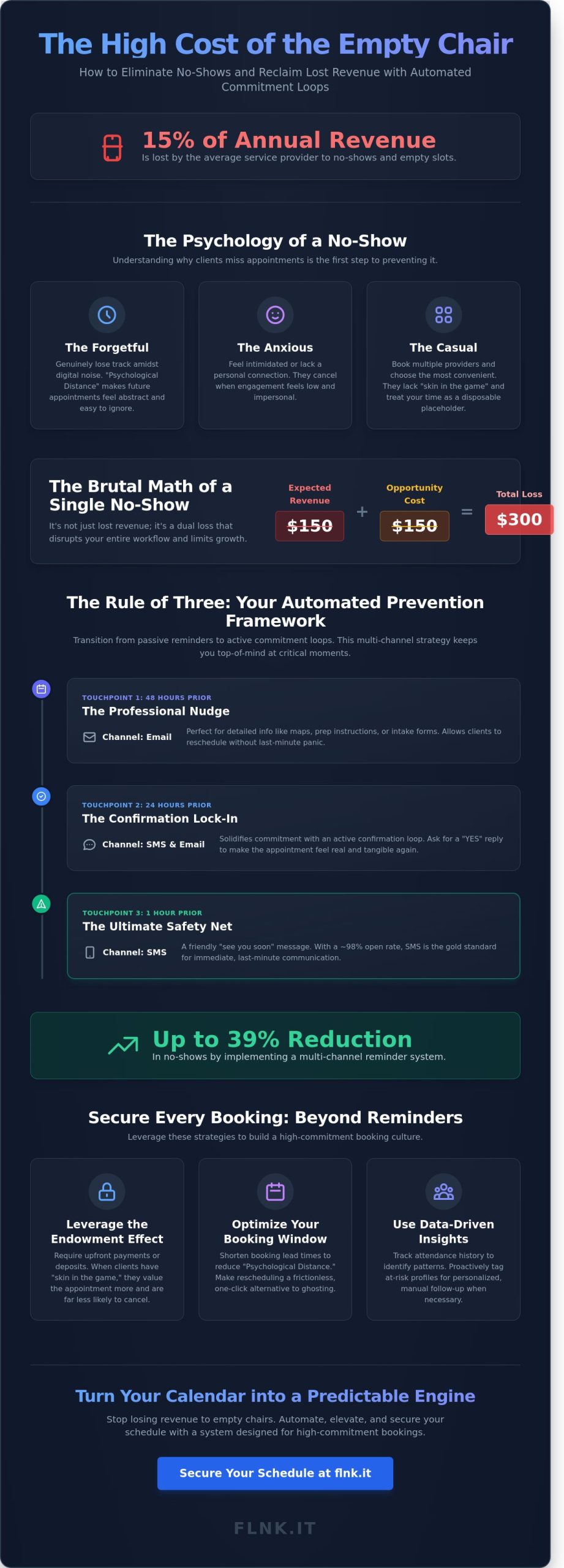
A no-show isn’t just a missed meeting. It’s a structural leak in your business. By 2026, industry data shows the average small service provider loses 15% of their annual revenue to empty chairs. Understanding how to reduce client no-shows starts with decoding human behavior. The “Psychological Distance” theory explains why long booking gaps lead to forgetfulness. If a client books an appointment 21 days in advance, the event feels abstract. It lacks the urgency of a same-day task. Memory fades as the gap grows, making the slot easy to ignore. Without a physical or digital anchor, your appointment is just another line in a crowded calendar.
The primary driver for casual cancellations is a lack of “skin in the game.” When there’s no financial or social risk, the appointment feels like a suggestion rather than a commitment. Most no-shows fall into three distinct categories:
- The Forgetful: They genuinely lose track of time amidst digital noise. They need more than one touchpoint to stay engaged.
- The Anxious: They feel intimidated by the service or the social interaction. These clients cancel when they don’t feel a personal connection to the provider.
- The Casual: They book multiple providers and choose the most convenient one at the last second. They treat your time as a placeholder.
The Financial Impact of Missed Slots
The math is brutal. If your hourly rate is $150, a 60-minute no-show represents a $300 loss. You lose the $150 you expected and the $150 opportunity cost from a waitlisted client you couldn’t serve. These gaps disrupt service quality for everyone else. They create jagged schedules that prevent you from reaching peak efficiency. For small business owners, the toll is also emotional. It creates a sense of instability that clouds professional confidence. Every empty chair is a missed chance to build a relationship or close a deal.
Why Traditional Reminders Are No Longer Enough
Notification fatigue is real. In 2026, the average professional manages over 120 emails and dozens of push notifications daily. A single reminder gets buried in seconds. While modern appointment scheduling software provides the infrastructure, the strategy must be more aggressive. Passive reminders are dead. You need active confirmation loops. Transitioning to dynamic booking systems allows you to move from “sending a notice” to “securing a commitment.” This shift forces a micro-interaction that makes the appointment feel real again. Learning how to reduce client no-shows requires moving beyond simple alerts toward these psychological triggers.
Implementing Multi-Channel Automated Reminders
Relying on a single notification is a high-stakes gamble. If you’re serious about learning how to reduce client no-shows, you must adopt the Rule of Three. This strategy uses SMS, email, and push notifications to stay top-of-mind. It’s not about pestering; it’s about providing a professional service that respects everyone’s time. Clear communication is the foundation of a reliable business relationship.
Timing determines your success rate. A 48-hour reminder allows clients to reschedule without a last-minute panic. The 24-hour follow-up solidifies the commitment. Finally, a 1-hour “see you soon” text serves as the ultimate safety net. Data suggests that multi-channel reminders can cut no-shows by up to 39% compared to single-channel systems. It’s a simple shift that yields immediate results.
Inconsistent attendance doesn’t just disrupt your workflow; it directly hinders client progress. For instance, research on therapy outcomes conducted at Brigham Young University shows that irregular attendance leads to measurably poorer results for the client. By automating your reminders, you aren’t just protecting your revenue; you’re ensuring your clients actually get the value they paid for. Efficiency benefits everyone involved.
The Power of SMS vs. Email
SMS is your most powerful tool for immediate action. With open rates hovering around 98%, it’s the gold standard for the final hour alert. Email serves a different purpose. Use it for the 48-hour mark to include detailed preparation instructions, parking maps, or intake forms. A sample high-converting text looks like this: “Hi [Name], we’re excited to see you at [Time] for your [Service] session; please reply YES to confirm or call if you need to reschedule!”
Personalisation and Brand Voice
Generic templates are easy to ignore because they feel automated and cold. To truly understand how to reduce client no-shows, you have to make the client feel expected. Use their name and mention the specific service they booked. This small touch builds immediate rapport and creates a sense of mutual respect. Your tone should remain modern and professional, reflecting a brand that values efficiency and progress.
Setting this up shouldn’t be a manual chore. You can use FastLinkIt email marketing to automate the entire follow-up sequence. This ensures every client receives a perfectly timed, personalized message without you lifting a finger. It’s a simple way to professionalize your booking process while reclaiming your time and focus for what matters most.
Securing Commitment Through Integrated Upfront Payments
Psychology plays a massive role in how to reduce client no-shows. The “Endowment Effect” suggests that people value things more once they have a financial stake in them. When a client pays even a small $10 commitment fee, they’re significantly more likely to show up compared to a free booking. This isn’t just about the money. It’s about a psychological contract. By asking for an upfront investment, you move the appointment from a “maybe” in their calendar to a confirmed priority.
Choosing the right payment structure depends on your business model. You have three primary paths to choose from:
- Full Payment: Best for high-demand, low-cost sessions where you want zero administrative work on the day of the appointment.
- Deposits: A 20% to 50% deposit covers your basic overhead and ensures the client is serious without requiring a large initial layout.
- Card on File: This “soft” commitment captures payment details without an immediate charge, allowing you to bill for late cancellations or no-shows later.
Introducing payments doesn’t have to alienate your audience. Modern clients value their time and yours. Position the change as a way to “guarantee their exclusive slot” in a busy schedule. You can integrate FastLinkIt payments directly into your booking link to keep the process frictionless. This creates a professional, one-touch experience that mirrors the efficiency of top-tier global brands.
Setting Up Your Payment Gateways
Speed is the enemy of abandonment. Flnk connects directly with Stripe, allowing you to accept global payments in seconds. This integration handles the heavy lifting, from secure data encryption to automatic receipts. If you need to handle how to reduce client no-shows effectively, automation is your best friend. The system can manage refunds or partial credits automatically if a client reschedules within your allowed window. This removes the “awkward” conversation about money and keeps your focus on the service you provide.
Transparency and Cancellation Policies
A policy only works if people see it. Your “No-Show” terms should be firm, fair, and impossible to miss. Don’t bury these rules in a long PDF. Display them clearly on your digital business card and within your booking flow. Use this URL Shortener Guide 2026 to create trackable links for your policy documents. This lets you see if clients are actually reviewing the terms before they click “confirm.” Transparency builds trust, and trust is the foundation of a reliable client relationship.
Optimising Your Booking Window and Rescheduling Flow
Long lead times are the silent killer of commitment. When a client books an appointment three weeks in advance, their initial excitement fades. Life happens. Priorities shift. Industry data shows that appointments scheduled more than 14 days out are 30% more likely to result in a no-show. You need to keep the intent fresh. Shorten your lead time to a maximum of 7 to 10 days. This creates a sense of immediate relevance and is a vital step in how to reduce client no-shows without adding extra work to your plate.
The “Frictionless” Rescheduling Loop
Ghosting often happens because the alternative feels like a chore. If a client has to search for a phone number or draft a formal email to cancel, they’ll likely just stay silent. You want them to cancel rather than disappear. A cancelled slot is an opportunity; a no-show is a total loss. Automate a rescheduling link directly within your reminder emails. Set a firm 24-hour cutoff time for changes. This provides a professional boundary while offering a graceful exit. It’s about making the right choice the easiest choice.
Managing Your Availability
Don’t let your calendar become a cluttered mess that looks desperate. Use “Short Booking Windows” to create urgency. If a client sees only three available slots for the upcoming week, they perceive your time as more valuable. Buffer your appointments by 10 or 15 minutes. This prevents a single late arrival from causing a domino effect of delays. For a deep dive on logistics, explore this Event Booking System Guide to refine your 2026 approach.
Friction in the booking process leads to a 20% drop-off rate in most service industries. Audit your user experience today. Every extra form field or unnecessary click is a chance for the client to bail. The FastLinkIt event booking system eliminates these hurdles with a sleek, mobile-first interface. It’s built for speed and high-conversion networking. You can also implement a digital “Waitlist” feature. When a client cancels within your allowed window, the system automatically notifies the next person in line. This ensures your revenue stays consistent even when schedules change.
Mastering your booking flow isn’t just about software; it’s about psychology. By making rescheduling easier than ghosting, you maintain the relationship even if the timing isn’t perfect. This proactive approach is the most efficient way to protect your most valuable asset: your time. Stop losing hours to empty chairs and start filling your calendar with committed leads.
Ready to transform your scheduling? Start using Flnk today to build a frictionless booking experience.
Building a Long-Term No-Show Prevention Strategy with FastLinkIt
Stop chasing. Start growing. Implementing a robust strategy for how to reduce client no-shows requires more than just a reminder text; it demands a sophisticated digital ecosystem. FastLinkIt replaces outdated paper diaries with a streamlined, digital-first workflow. This shift does more than just save trees. It saves time. By moving to a paperless system, businesses often reclaim 10 to 15 hours of administrative time every month. You aren’t just managing a calendar; you’re building a database.
The FastLinkIt Contact Management system allows you to track attendance history with precision. If a client has missed two appointments in the last six months, you need to know before they book a third. By tagging these “at-risk” profiles, you can automate specific workflows. For example, you might require a 50% deposit from any client tagged as a frequent no-show. This isn’t about being difficult. It’s about protecting your time and ensuring your business remains sustainable. You’re moving away from the “franken-stack” of disconnected apps and into a unified professional front.
Data-Driven Decision Making
Industry data suggests that no-show rates can hover around 18.8% in service-based sectors. You can’t fix what you don’t measure. FastLinkIt analytics provide the clarity needed to spot trends before they become crises. You might discover that your 4 PM Friday slots have a 25% higher skip rate than Tuesday mornings. Or perhaps you see a significant drop-off at the final step of your booking flow. Identifying these friction points allows you to optimize your funnel and keep your schedule full. Knowledge is the first step toward 100% attendance.
The All-in-One Solution for Modern Professionals
Modern clients expect a seamless experience. When you share your bio link or display a QR code, you’re presenting a unified brand. FastLinkIt integrates payments, CRM, and booking into a single point of contact. This eliminates the confusion that often leads to missed appointments. When the booking process is easy, clients are more likely to commit. It’s a professional, contactless approach that fits the lifestyle of the modern entrepreneur. You’re not just a service provider; you’re a tech-forward professional who values efficiency and sustainability.
Turn Missed Slots Into Guaranteed Growth
An empty chair isn’t just a missed appointment; it’s a direct hit to your bottom line. You’ve seen that mastering how to reduce client no-shows requires a mix of psychology and precision technology. By 2026, manual follow-ups are a relic of the past. Success now depends on Stripe-powered secure payments that lock in commitment and automated email and SMS notification workflows that keep your brand top-of-mind. Industry data from MGMA indicates that text reminders alone can cut missed appointments by 39%. When you combine this with integrated contact management for at-risk clients, you don’t just fill slots; you build a high-commitment culture. FastLinkIt provides the sleek, app-free interface your modern clients expect while stripping away the friction of traditional booking. It’s time to stop chasing ghosts and start building a predictable, profitable schedule. Your business deserves this level of precision and ease. Let’s make every booking count.
Master your schedule and stop losing revenue – get started with FastLinkIt for free
Frequently Asked Questions
Is it legal to charge a no-show fee if the client doesn’t show up?
It’s legal to charge a no-show fee if you’ve clearly stated it in your terms and conditions before the booking. According to the UK Consumer Rights Act 2015, fees must be fair and shouldn’t exceed the actual loss you suffered. You can’t profit from a missed slot, but you can recover lost revenue. Make sure your clients sign a digital waiver or check a box during the booking process.
How much should a no-show deposit be for a service-based business?
Most service-based businesses set their no-show deposits between 25% and 50% of the total service cost. A 2023 industry report from Phorest Salon Software indicates that a 50% deposit reduces ghosting rates by nearly 70%. It’s a balance between securing your time and not scaring off new leads. High-value services often require a larger upfront commitment to ensure the client stays accountable.
What is the best way to tell a client they are being charged for a missed appointment?
The best way to inform a client of a charge is through a direct, automated notification that references your agreed-upon policy. Use a script like: “Per our policy signed on June 1st, a fee’s been applied to your account for the missed session.” Don’t apologize for protecting your time. Transparency builds respect and ensures your professional boundaries remain firm and respected.
Can automated reminders actually reduce no-shows by more than 50%?
Automated reminders can reduce no-shows by 66%, according to data from the Medical Group Management Association. This is a critical part of how to reduce client no-shows without manual effort. Sending a text 24 hours before the slot keeps your service top-of-mind. It’s a simple tech fix that saves hours of follow-up time every single week.
Should I fire a client who consistently misses appointments?
You should consider terminating the relationship if a client misses three appointments within a six-month period. Data shows that chronic no-showers cost small businesses an average of $26,000 annually in lost revenue. Your time’s your most valuable asset. Firing a problematic client opens up space for someone who respects your schedule and pays on time without excuses.
How do I integrate a payment system into my existing booking link?
You can integrate a payment system by connecting your Stripe or PayPal account directly to your booking platform’s API. Most modern tools allow you to toggle “require payment” in the settings menu of your scheduling link. This ensures the transaction happens before the slot’s confirmed. It’s a frictionless way to handle finances while keeping your digital profile professional and efficient.
What should I do if a client has a legitimate emergency and misses their slot?
You should waive the fee for a first-time emergency to maintain long-term client loyalty. Statistics show that 85% of clients are more likely to return if a business shows empathy during a genuine crisis like a car accident. Document the occurrence in your CRM. If it happens a second time, you must enforce your policy to protect your bottom line.
How do I track my no-show rate using FastLinkIt?
Tracking your no-show rate with FastLinkIt involves monitoring the analytics dashboard to compare scheduled events against completed interactions. This data gives you a clear picture of how to reduce client no-shows by identifying which days or services have the highest abandonment rates. Use these insights to tweak your reminder frequency. Precision in your data leads to better, faster business decisions.