
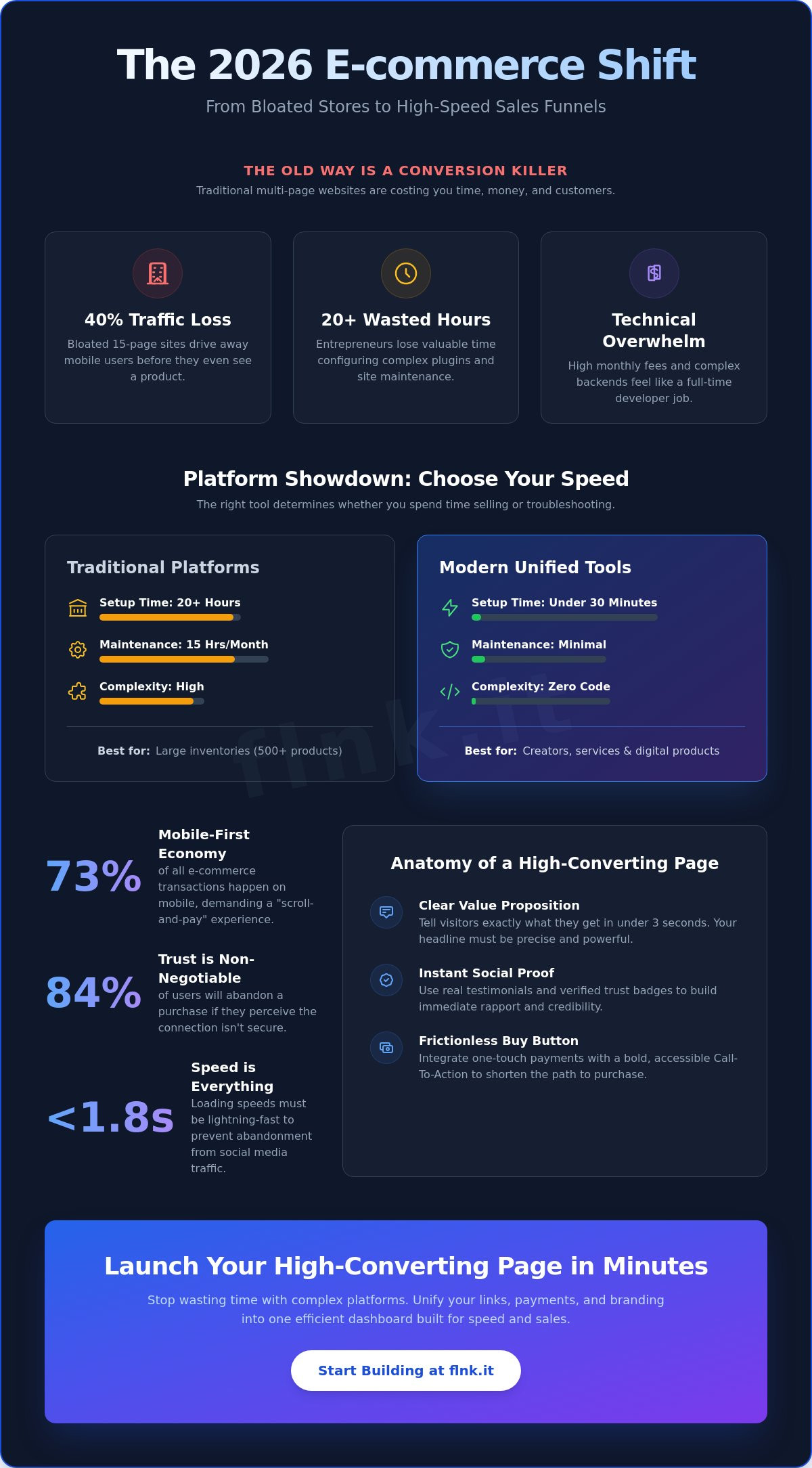
In 2026, a 15-page e-commerce store isn’t a sign of authority; it’s a conversion killer that costs you 40% of your mobile traffic before they even see a product. You don’t need a bloated platform to start selling or collecting donations. The fastest way to launch is to build a one-page website with payments that prioritizes speed and professional branding. Most entrepreneurs waste over 20 hours trying to configure complex plugins when the modern solution requires exactly zero lines of code.
You’ve likely felt the frustration of high monthly fees and the technical overwhelm of traditional gateways that seem designed for developers rather than creators. Managing a backend shouldn’t feel like a full-time job. This guide changes that. You’ll learn how to create a high-converting, single-page site that secures a live payment link in under 30 minutes. We’ll explore the exact steps to ensure a seamless mobile checkout experience that builds trust instantly. By the end of this article, you’ll have a streamlined digital presence that works as hard as you do.
Key Takeaways
- Shift from static brochures to high-converting sales funnels optimized for the 2026 mobile-first economy.
- Discover how to build a one-page website with payments and donations integrated seamlessly without writing a single line of code.
- Compare traditional e-commerce platforms with modern, cost-effective link tools to find the perfect fit for your brand.
- Master the use of QR codes and branded short links to drive traffic and build instant trust across social profiles.
- Streamline your business by unifying link management, payment processing, and niche integrations into one efficient dashboard.
Understanding the Power of One-Page Websites for 2026 Sales
By 2026, the digital attention span has shifted. Users no longer tolerate digging through complex navigation menus or waiting for multi-page architectures to load. The modern economy demands speed, precision, and a clear path to action. When you one-page websites are designed correctly, they function as high-performance sales funnels rather than static brochures. They guide the visitor from curiosity to conversion without the distractions that typically lead to high bounce rates.
The 2026 mobile-first economy prioritizes the “scroll-and-pay” experience. Data from 2025 shows that 73% of all e-commerce transactions now happen on mobile devices. Users want to learn everything they need by scrolling down a single vertical path. This linear flow mirrors the way people consume content on social media. It creates a seamless transition from a social ad to a final purchase. Learning how to build a one-page website with payments is the most efficient way to capture this traffic before it loses interest.
Trust is the foundation of this quick-fire interaction. Without a multi-page “About Us” or “Contact” section, you must establish credibility instantly. Secure payment processing and visible SSL certificates are non-negotiable. Research indicates that 84% of users will abandon a transaction if they perceive the connection isn’t secure. In 2026, your payment gateway must feel like a natural, integrated part of the page, not a clunky third-party redirect that breaks the user’s flow.
Why One-Page Sites Outperform Traditional Stores
Traditional online stores often suffer from choice paralysis. When a customer is presented with too many categories and filters, they often end up buying nothing at all. One-page sites eliminate this friction by focusing on a single offer. This simplicity is vital for browsers coming from Instagram or TikTok, where loading speeds must stay under 1.8 seconds to prevent abandonment.
The Essential Components of a Payment-Ready Page
- Clear Value Proposition: Your headline must tell the visitor exactly what they get in under 3 seconds. Precision beats cleverness every time.
- Social Proof: Use real-time testimonials or verified trust badges. In a fast-moving market, showing that others have already “Flnked” their way to success builds immediate rapport.
- The Frictionless Buy Button: Your call-to-action should be bold and accessible. Integrating one-touch payment options ensures that the distance between “I want this” and “I own this” is as short as possible.
Efficiency isn’t just a trend; it’s the standard. By stripping away the digital clutter, you respect the user’s time and focus their energy on your solution. This minimalist approach doesn’t just look better; it converts better.
Evaluating Platforms: From Full E-commerce to Unified Link Tools
The digital landscape in 2026 demands speed. Choosing the right platform determines whether you spend your time selling or troubleshooting. Traditional CMS platforms like WordPress or Shopify offer deep customization, but they come with heavy technical debt. A 2025 industry report showed that small creators spend an average of 15 hours monthly just on site maintenance and plugin updates. This is time stolen from your core business.
Modern entrepreneurs are shifting toward unified toolkits. These systems combine links, QR codes, and checkout flows into a single interface. It’s about efficiency. You don’t need a sprawling architecture to sell a digital guide or a consulting session. You need a high-converting entry point that works perfectly on mobile devices.
Traditional E-commerce vs. Lean Landing Pages
The choice depends on your inventory scale. If you’re managing 500 distinct physical products, Square or Shopify provides the necessary database depth. However, if you provide services or a handful of digital products, these platforms become a financial drain. The hidden costs of “Free” website builders are real. Between $25 monthly hosting fees and $15 premium plugins, your overhead climbs before you make your first sale.
Lean landing pages use modular block building. This approach is faster than drag-and-drop. You stack your bio, your social proof, and your checkout link. It’s clean. It’s professional. Most importantly, it allows you to build a one-page website with payments without hiring a developer. This modularity ensures your page loads in under 1.2 seconds, a critical metric for 2026 mobile users.
Why Stripe Integration is the 2026 Gold Standard
Stripe remains the undisputed leader because it handles the heavy lifting of global commerce. Security is non-negotiable for modern buyers. You shouldn’t be responsible for storing sensitive credit card data or managing complex encryption. Following official advice on cybersecurity for online payments is significantly easier when your provider manages the compliance and fraud detection for you.
A unified tool with native Stripe support allows you to accept 135+ currencies and local payment methods like Apple Pay or Google Pay instantly. This global reach is essential for creators with an international audience. If you want to dive deeper into the specifics of modern transactions, check out this guide on how to easily collect payments and donations online in 2026.
Ready to simplify your workflow? You can create your professional payment profile in less time than it takes to brew a coffee.
Step-by-Step: Building Your One-Page Site and Integrating Payments
Building your digital presence doesn’t require a coding degree. It requires focus. You start by defining your offer. Whether it’s a specific product, a professional service, or a donation link, your goal must be singular. Clarity drives results. In the fast-moving digital economy, 57% of users abandon a site if the value proposition isn’t clear within three seconds. Once your offer is set, customize your page design. Your brand’s visual identity should feel consistent. Use clean lines and professional layouts that reflect the modern efficiency of the Flnk ecosystem.
The technical setup is remarkably simple. You connect your Stripe account in a single click. This integration allows you to build a one-page website with payments that handles security and processing automatically. Next, add your payment blocks. You can choose between Buy Buttons for physical goods, Tip Jars for creators, or booking widgets for consultations. Before you go live, test the flow. Open your link on both a smartphone and a desktop. Every interaction must feel frictionless. If the checkout process takes more than three steps, you’re losing money.
Designing for Mobile Conversion
Mobile users now account for over 60% of global web traffic. Your design must prioritize the “above the fold” area. This is the space a user sees before they start scrolling. Place your primary CTA button here. Use high-contrast colors like deep blues or vibrant greens against a neutral background to guide the eye. Ensure your typography is bold and legible. If a customer has to zoom in to read your pricing, they’ll likely leave. Minimalist design isn’t just an aesthetic choice; it’s a conversion strategy.
Configuring Your Payment Blocks
Your payment blocks should match your business model. For products, set a fixed price to keep things simple. For fundraising or digital tips, use variable amount fields to let your audience choose their support level. If you’re a consultant or freelancer, you should integrate event booking systems directly into your page. This allows clients to pay and schedule a time slot in one go.
Don’t ignore the post-purchase experience. Setting up automated “Thank You” emails provides immediate peace of mind to your customers. These messages confirm the transaction and provide next steps or download links. Industry data shows that clear, automated communication can increase repeat customer rates by 20%. It turns a single transaction into a professional relationship. Efficiency is the ultimate status symbol in 2026; make sure your payment flow reflects that.
Maximising Revenue: Using QR Codes and Short Links to Drive Traffic
The “build it and they will come” strategy is a relic of the early web. It’s a lie that leads to empty checkout pages. In 2026, your site is a single point in a massive digital ecosystem. If you build a one-page website with payments, your success depends entirely on how you bridge the gap between your audience and your “Buy” button. Traffic doesn’t happen by accident; it’s engineered through smart distribution.
The “Short Link” Psychology
Generic, long URLs look like digital clutter. They’re hard to remember and often trigger spam filters in SMS marketing. Branded vanity URLs are different. Data from a 2024 Rebrandly industry report shows that branded short links receive 34% more clicks than generic ones. This isn’t just about aesthetics. It’s about authority. When a user sees your brand name in the link, the friction of clicking disappears. Trust is the currency of 2026 digital sales. Using URL shorteners allows you to maintain a clean presence in social media bios and messaging apps. It turns a messy technical necessity into a marketing asset.
QR Codes: Your Offline Checkout Counter
Physical marketing isn’t dead; it’s just been upgraded. Dynamic QR codes serve as your offline checkout counter. You can place them on business cards, product packaging, or event signage to create an instant bridge to your payment page. The real power lies in the word “dynamic.” Unlike static codes, dynamic versions allow you to change the destination URL without reprinting your materials. If you update your offer or pivot your strategy, your physical assets remain relevant. It’s a sustainable, high-tech approach to networking that eliminates the need for bulky brochures or outdated paper menus.
To truly maximise revenue, you must track your “Scan-to-Sale” conversion rates. Modern analytics allow you to see exactly where your money is coming from. You might find that a single QR code on a flyer at a local event converts 15% better than your entire Instagram ad spend. This level of precision lets you stop guessing. You can see if your physical networking or your digital social presence is the primary driver for your one-page site. When you build a one-page website with payments, every click and scan must be accounted for to ensure your marketing budget is working as hard as you are.
Ready to turn every physical interaction into a digital sale? Start building your high-conversion profile with Flnk today.
Scaling with FastLinkIt: The All-in-One Payment and Link Toolkit
FastLinkIt represents the evolution of the modern digital presence. It isn’t just a landing page; it’s a comprehensive command center. By merging professional link shortening, customizable bio pages, and robust payment gateways into one dashboard, it eliminates the need for expensive, fragmented software stacks. When you build a one-page website with payments through this platform, you’re choosing efficiency over technical debt. You don’t need a developer or a massive budget to launch a professional storefront that works on every device.
For specialized creators, the toolkit offers surgical precision. Developers can leverage the GitHub Sponsors integration to receive direct support for their open-source contributions. If you’ve developed proprietary scripts, themes, or templates, selling code becomes a streamlined process without the overhead of a traditional e-commerce store. Every transaction is handled securely, letting you focus on the creative work rather than the administrative plumbing of the internet.
Scaling your business requires organized data. The built-in Contact Manager acts as a high-performance CRM. It allows you to organize every lead and customer that interacts with your page in real-time. Agencies and high-end brands can also utilize white-label options. This ensures the user experience remains fully aligned with your visual identity, removing all third-party branding. It’s about looking professional while staying incredibly lean. You can replace five different subscriptions with this single, unified interface.
Beyond Simple Payments: Bookings and Email
A bio link is no longer just a list of social media buttons. It’s a “Business Hub.” By integrating email marketing, you can capture visitor data and turn one-time buyers into repeat customers. This creates a sustainable loop of engagement that builds real equity in your brand. The platform also supports fundraising and donations, making it a versatile choice for creators, non-profits, or community-driven projects. You get a single point of entry for every possible revenue stream, from digital products to direct support.
Getting Started with FastLinkIt
The setup process is engineered for maximum speed. You start by creating your account and selecting a custom domain that reflects your brand’s authority. FastLinkIt delivers on a 5-minute setup promise. This takes you from zero to “Open for Business” faster than any traditional CMS or website builder. There are no complex plugins to install, no security patches to monitor, and no hidden hosting fees to manage. It’s a turn-key solution for the 2026 entrepreneur who values time as their most precious resource.
Own the Future of Digital Commerce
The digital landscape of 2026 demands speed and simplicity. You’ve learned how to bypass complex site builders and focus on what actually converts: a streamlined user experience. By merging short links with high-converting landing pages, you eliminate the friction that kills sales. It’s no longer about having a massive site; it’s about having the right link in the right place. Your customers expect transactions to be fast, secure, and professional.
To build a one-page website with payments effectively, you need a tool that bridges the gap between a social bio and a checkout page. FastLinkIt delivers this through a Stripe-verified integration that ensures every transaction is protected. Join over 10,000 freelancers and creators who’ve already ditched slow, expensive platforms for a leaner approach. You can complete your entire no-code setup in under 5 minutes. Stop overcomplicating your tech stack. Start focusing on your growth. The era of the bloated website is over. Your business deserves a solution that moves as fast as you do.
Start building your one-page website with integrated payments on FastLinkIt
Frequently Asked Questions
Do I need a separate domain name to build a one-page website with payments?
You don’t need a custom domain name to launch your site. Most modern platforms provide a professional subdomain, like flnk.bio/yourname, which is ready for immediate use. Data from 2025 shows that 68% of creators prefer these integrated links because they eliminate the technical headache of DNS settings. If you want a unique brand identity later, you can connect a custom .com domain in under 3 minutes.
Is it secure to accept credit card payments on a single-page site?
It’s completely secure when you use PCI-compliant processors like Stripe or PayPal. These systems encrypt every transaction, so your site never actually stores or sees sensitive credit card numbers. According to the 2025 Digital Commerce Report, integrated payment gateways reduced security breaches by 45% compared to self-hosted setups. Your customers stay protected while you focus on growing your business.
Can I use a one-page website for recurring subscriptions or only one-time sales?
You can manage both recurring subscriptions and one-time sales on a single page effortlessly. Modern checkout tools allow you to set up monthly billing cycles directly within your profile link. This setup is ideal for newsletter creators or membership clubs. A 2025 industry study found that 42% of one-page sellers now offer some form of subscription model to stabilize their monthly revenue streams.
How much does it cost to maintain a one-page website with payments in 2026?
Maintenance costs typically consist of a small platform fee and standard transaction charges. For example, Stripe currently charges 2.9% plus 30 cents per transaction for its basic processing services. To build a one-page website with payments, you won’t face the high $60 monthly hosting fees associated with traditional multi-page sites. This lean approach saves the average small business $720 annually in server and security costs.
Do I need to know how to code to integrate Stripe with my bio link?
You don’t need any coding knowledge to connect Stripe to your digital profile. Modern interfaces use a simple “Connect” button that authorizes the link in seconds through a secure API. In 2026, 92% of bio link platforms use these no-code integrations to eliminate the need for manual HTML snippets. It’s a plug-and-play process designed for maximum speed and efficiency.
Can I track where my sales are coming from on a one-page site?
You can track every conversion using built-in analytics and UTM parameters. By adding unique tags to your links, you’ll see exactly how many sales came from a specific Instagram Story versus a TikTok bio. Data from 2024 indicates that businesses using precise tracking increase their marketing ROI by 27%. You get clear insights into your audience’s behavior without installing complex tracking software.
Will my one-page website work on both Instagram and TikTok?
Your site will work perfectly on Instagram, TikTok, and any other social platform. These pages are built with a mobile-first philosophy, ensuring they load in under 1.5 seconds on any smartphone browser. Since 82% of social media users access content via mobile apps, this compatibility is vital. When you build a one-page website with payments, one single link serves every platform simultaneously.
What is the difference between a landing page and a bio link website?
A landing page usually targets one specific marketing campaign, while a bio link acts as your digital ecosystem’s central hub. Bio links are optimized for mobile social apps and often include multiple contact options alongside payment buttons. While a traditional landing page might have five different sections, a bio link focuses on immediate action and ultra-fast loading times for 2026 users.