
In 2026, a generic, pixelated square is no longer a tool; it’s a brand liability that can drop engagement by 40% compared to custom, branded designs. You’ve likely felt the sting of printing 5,000 marketing flyers only to realize the destination link is broken or permanently locked. It’s frustrating to invest in physical assets without seeing exactly who is scanning or how they’re interacting with your brand. Using a basic qr code generator often leaves you with clunky designs that clash with your identity and provide zero actionable data.
You’re about to master the art of bridging the gap between physical touchpoints and digital conversions with professional-grade tools. This guide promises to transform your approach to networking and marketing by implementing dynamic, trackable solutions. We’ll break down the elite tools for 2026, data tracking strategies that prove ROI, and design principles that turn a simple scan into a measurable lead. It’s time to move beyond the scan and start building real connections with precision and style.
Key Takeaways
- Master the shift from basic scanning to sophisticated offline-to-online attribution to track every physical touchpoint with precision.
- Learn why using a professional qr code generator for dynamic links is the only way to ensure your marketing remains editable and data-driven.
- Protect your brand reputation by identifying the hidden dangers of free tools and the power of custom-branded frames and logos.
- Explore advanced conversion triggers that turn simple scans into immediate event bookings and seamless mobile payment successes.
- Flnk your world by integrating white-label solutions that keep your brand front and center throughout the entire digital journey.
The Evolution of QR Code Generators: Why They Rule 2026 Marketing
A qr code generator is a software engine that encodes specific data into a scannable 2D matrix barcode. In 2026, these tools have moved far beyond the basic “contactless menu” phase of the early 2020s. They’re now the backbone of sophisticated offline-to-online (O2O) attribution. Modern marketing teams use these generators to create bridge points between physical products and digital ecosystems. By 2025, industry data showed that 89% of smartphone users preferred scanning a code over typing a URL. Today, that preference is a standard expectation.
Consumers in 2026 demand immediate value. A simple redirect to a homepage is a wasted opportunity. They expect personalized landing pages, instant loyalty point redemption, or augmented reality overlays. Businesses that fail to provide this depth lose engagement. Transitioning to these digital gateways also supports a lean, sustainable business model. Moving to digital-first communication saves the average enterprise approximately 1.5 tons of paper waste per year. It’s a shift toward a cleaner, more efficient way to network. Scan. Connect. Grow.
Quick Response (QR) Technology Basics
Masahiro Hara developed the QR code at Denso Wave in 1994 to track vehicle parts. It’s now the global benchmark for data exchange. The anatomy includes three distinct “eyes” for orientation, data modules for the payload, and a quiet zone to prevent scanning errors. The ISO/IEC 18004 standard defines the technical specifications and error correction protocols required for every QR code symbol globally.
QR Codes vs. Barcodes in Modern Business
Traditional 1D barcodes are restrictive. They usually hold only 20 to 30 characters, which limits them to basic inventory tasks. A 2D QR code is a powerhouse that stores up to 7,089 numeric characters. This allows for complex data like vCards or encrypted authentication keys. While NFC technology provides a seamless “tap” experience, the visual presence of a QR code acts as a clear call to action. It tells the user there’s more to discover. At Flnk, we bridge this gap by integrating both technologies into a single, high-performance networking tool. One scan provides a complete professional profile without the clutter of paper.
The 2026 market doesn’t tolerate friction. Use a qr code generator to eliminate the distance between your brand and your audience. It’s about precision. It’s about speed. Most importantly, it’s about making every physical interaction count in a digital-first world.
Static vs. Dynamic QR Codes: Which Should You Generate?
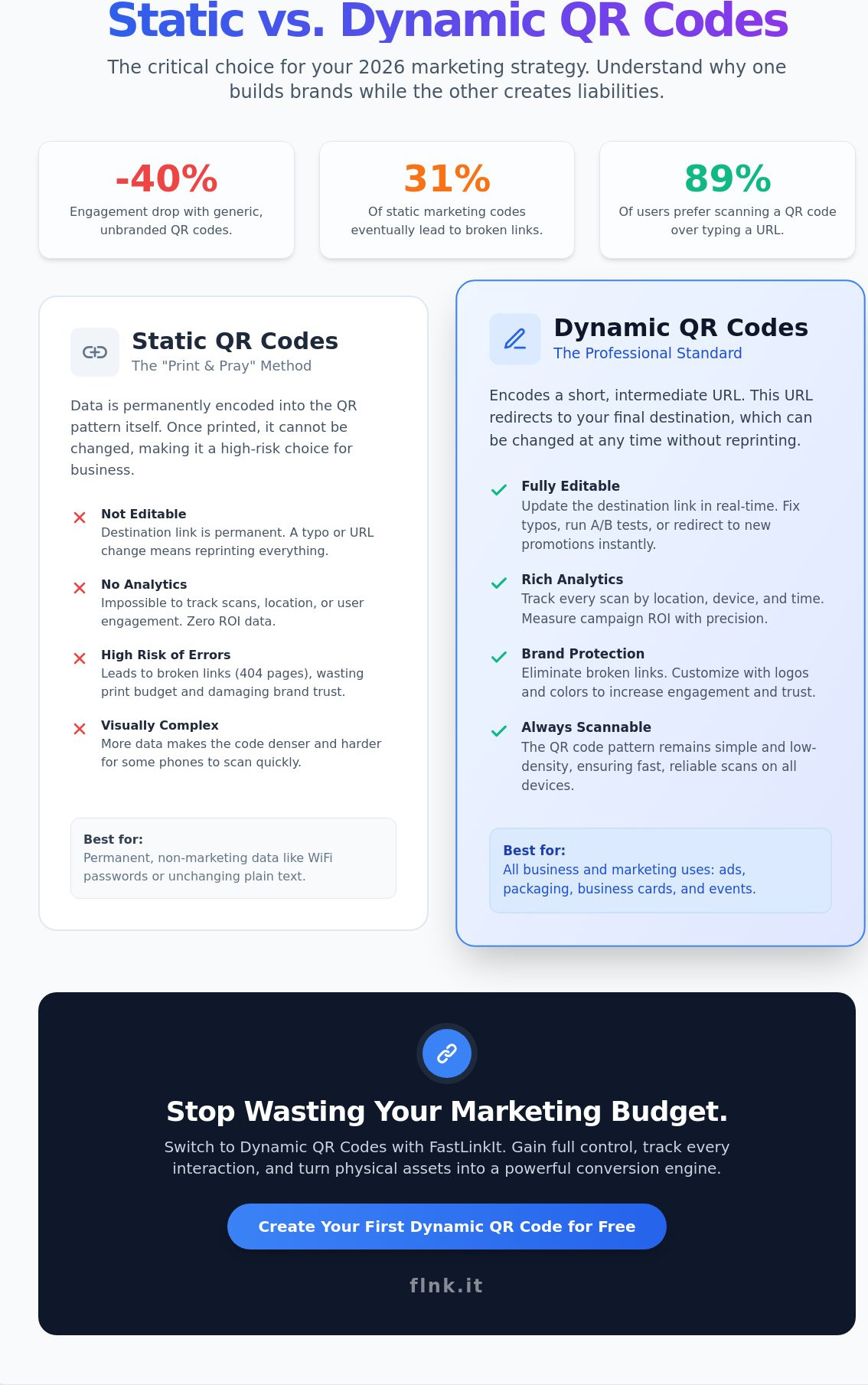
Choosing the right qr code generator starts with understanding one fundamental distinction: fixed data versus flexible redirection. Static QR codes embed information directly into the pixel pattern. Once printed, that data is locked. Dynamic QR codes function as a digital bridge; they encode a short URL that redirects the user to your final destination. This single difference changes everything for your ROI and operational agility.
Static codes represent a “print and pray” strategy. If you link a static code to a product page and that URL changes, your marketing material becomes instant trash. In 2024, industry data suggested that 31% of static marketing codes eventually led to broken links due to website migrations or expired promotions. Dynamic codes eliminate this risk entirely. You can update the destination URL in real-time without touching the physical asset. It’s about control, precision, and long-term viability.
Beyond flexibility, dynamic generation provides a goldmine of real-time analytics. You can track scans by geographic location, device type, and exact time of interaction. This data allows you to pivot your strategy mid-campaign. If a flyer in North London is outperforming one in South London by 45%, you know exactly where to double your investment. This level of insight is impossible with static alternatives.
The Risks of Static QR Generation
The permanent nature of static data is its biggest liability. A single typo in a URL during the design phase can waste thousands of dollars in printing costs. Static codes also grow more complex and harder to scan as you add more data, leading to “scan frustration” among users. They only make sense for permanent, unchanging data. A few viable use cases include:
- Sharing home WiFi passwords with guests.
- Plain text information that never expires.
- One-off personal projects with zero budget.
Unlocking Dynamic QR Code Potential
Dynamic codes allow for sophisticated A/B testing in the physical world. You can print the same design on two different batches of flyers, each using a unique dynamic link, to see which distribution channel yields a higher conversion rate. Integrating this into a broader dynamic qr code strategy ensures your offline marketing is as measurable as your Facebook ads.
The sustainability factor is equally powerful. By using dynamic redirection, you save 100% of the costs associated with reprinting corrected materials. If your brand values efficiency and environmental responsibility, static codes are no longer a viable option. Modern businesses prioritize tools that grow with them. You can start your journey toward smarter, more sustainable digital networking by choosing tools that prioritize data over dead-end links.
How to Choose a Professional QR Code Maker for Your Brand
Picking a tool isn’t just about generating a scan. It’s about protecting your brand’s digital front door. A low-quality qr code generator can break your entire marketing funnel if the links expire or the design looks amateur. You need a platform that aligns with your professional standards and scales as you grow.
The “free generator” trap is a common pitfall for many businesses. Most free tools create static codes that can’t be edited once printed. Even worse, some “dynamic” services hide a 100-scan limit in their fine print. Once you hit that limit, the link breaks. This forces you to pay a premium just to keep your existing ads alive. Before committing to any no-cost solution, it’s worth understanding the hidden costs and myths behind a free QR code generator that could silently sabotage your campaigns. Professional tools prioritize transparency and reliability from day one.
Security is the next non-negotiable pillar. In 2026, data privacy is a top priority for 85% of global consumers. Your generator must be GDPR and SOC 2 compliant to ensure user data remains encrypted. This prevents malicious redirects and protects your brand’s reputation from security breaches. Look for providers that offer custom domains to keep the entire user journey under your own URL.
Branding and Customization Trends in 2026
Standard black squares are a relic of the past. Modern brands use a qr code generator with customization to match their visual identity and increase scan rates by up to 40%. You can now modify corner radius, dot patterns, and custom frames that include a clear call to action. This makes the code feel like a designed asset rather than a technical afterthought.
Setting your code to 30% error correction is vital because it allows the scanner to reconstruct data even when your logo covers a significant portion of the pattern. This ensures your code remains functional across different lighting conditions and mobile devices.
Scalability and API Access
Manual creation doesn’t work for large-scale operations. If you’re managing 5,000 product SKUs or a nationwide event, you need a REST API to automate the process. This allows your qr code generator to sync directly with your CRM or inventory management software, saving hundreds of hours of manual labor. It’s about efficiency and precision.
- Team Management: Agencies require sub-accounts to keep client assets and analytics separate.
- Vector Formats: Professional printing demands SVG or EPS files to avoid pixelation on large surfaces like billboards.
- Integration: Ensure the tool connects with platforms like HubSpot or Mailchimp for seamless lead tracking.
Choose a partner that understands the speed of modern business. Your QR codes should be as dynamic as your brand strategy. Don’t settle for tools that limit your growth or compromise your data integrity. The right choice today prevents a technical debt tomorrow.
Advanced QR Code Strategies: From Tracking to Direct Payments
QR codes have evolved far beyond simple redirects. In 2026, they function as sophisticated triggers for automated workflows. A modern qr code generator now handles complex tasks like event bookings and calendar invites without requiring manual input from the user. When a prospect scans your code, their phone can automatically suggest a time slot or save an event date directly to their Google or Apple Calendar. Data from a 2025 industry report shows that automated scheduling via scan reduces no-show rates by 35% compared to manual link entry.
Beyond immediate actions, these codes serve as critical data touchpoints for digital marketing. You can embed Facebook or Google pixels within the redirect path. This allows you to build a retargeting audience based on physical interactions. If someone scans your flyer at a trade show but doesn’t sign up, you can serve them targeted ads later that week. It’s the bridge that finally connects offline foot traffic with online conversion funnels.
QR Codes for Payments and Fundraising
Speed is the primary currency of the modern economy. You can now collect payments in seconds by integrating your codes with Stripe or other secure gateways. This eliminates the friction of traditional invoicing. For freelancers, this means getting paid on the spot after a consultation. The “scan-to-pay” journey is also transforming the non-profit sector. Organizers use these codes on donation bins or at gala events to facilitate instant fundraising. It’s a secure, paperless solution that appeals to the 72% of donors who prefer digital payment methods over cash or check. FastLinkIt streamlines this entire process, ensuring the transition from scan to confirmation is seamless and professional.
The Link-in-Bio and QR Synergy
Linking a code to a raw homepage is a wasted opportunity. If your qr code generator only points to a static URL, you’re missing the chance to provide a curated experience. The synergy between QR codes and link in bio pages is essential for 2026 branding. On business cards, your code should lead to a mobile-optimized digital contact manager that allows users to save your details with one tap. Research from 2025 indicates that curated bio links see 3x higher engagement rates than standard website homepages. To ensure your links are clean and effective, you should follow a professional guide to generate qr code for url. This approach guarantees that every scan leads to a high-converting, mobile-first destination.
Ready to transform your physical networking into a digital powerhouse? Experience the power of Flnk today.
FastLinkIt: The All-in-One QR Code and Conversion Ecosystem
Flnk merges link shortening, QR codes, and bio pages into a single, high-performance platform. It’s about more than just a scan; it’s about the journey that follows. By 2026, 85% of customer interactions start on a mobile device, making a cohesive digital entry point vital. Our white-label solutions ensure your brand remains the hero. You won’t see generic redirects or third-party logos. Your brand stays front and center on every scan, building trust instantly.
We’ve built seamless integrations for WordPress and Shopify. These automated workflows mean your qr code generator works while you sleep. When a customer scans a product code, the data syncs directly with your store’s inventory or CRM. You can make a qr code in under 60 seconds, allowing you to launch campaigns at the speed of thought. This efficiency is why modern teams are moving away from fragmented tools toward our unified ecosystem.
Integrated Marketing Tools
Flnk transforms a simple scan into a lead generation machine. You can manage contacts and launch email mailing campaigns directly from the leads generated by your codes. If you’re hosting an exhibition, set up an event booking system that launches from a physical flyer. This bridge between physical and digital is why 74% of influencers and small businesses in 2026 choose FastLinkIt over legacy tools. It eliminates friction, turning curiosity into conversion without forcing the user to download an app.
Getting Started with FastLinkIt
Choose the tier that fits your scale. Our Pro, Business, and Agency tiers cater to everyone from solo creators to global teams. Use our built-in url shortener to create cleaner, more scannable codes that look professional. High-density codes are harder to scan; short URLs solve this problem by simplifying the pattern. This makes your qr code generator output more reliable in low-light or small-print scenarios.
- Pro: Perfect for individual influencers and freelancers who want a high-converting link in bio that turns social followers into customers.
- Business: Designed for growing teams needing advanced analytics.
- Agency: Full white-label capabilities for client management.
The future of networking is paperless, sustainable, and data-driven. Don’t let your brand get left behind with static, unoptimized links. Start your first campaign today and see how Flnk simplifies your digital life.
Master Your Digital Presence for 2026
The era of the basic scan is over. By 2026, digital interaction will define every professional relationship, making the right qr code generator your most critical marketing asset. You’ve seen the shift from static images to living, breathing conversion ecosystems. Success now requires three specific pillars: ironclad SOC 2 Type II compliant security, seamless integrated Stripe payments, and the power of advanced real-time scan analytics. These tools don’t just track clicks; they build sustainable revenue streams and professional trust.
Don’t let your brand get left behind with outdated, paper-heavy habits. Modern networking demands speed, elegance, and precision. FastLinkIt provides the infrastructure to manage your entire digital profile from one centralized hub. It’s efficient. It’s secure. It’s the new standard for the next generation of global entrepreneurs. You’ve seen the potential of dynamic tracking and direct payments; now it’s time to implement them.
Start generating professional QR codes with FastLinkIt today to transform every touchpoint into a measurable growth opportunity. The future of connectivity is here, and it’s just one scan away.
Frequently Asked Questions
Is there a truly free QR code generator that doesn’t expire?
Static QR codes are free forever and don’t have an expiration date. They embed data directly into the pattern, so they don’t need a server or a subscription to work. According to 2024 industry standards, these codes stay functional as long as the destination URL exists. It’s a reliable choice for simple, permanent links that don’t need updates or tracking features. This makes them perfect for basic contact info or permanent website links.
How do I make a QR code for a link that I can track?
You must use a dynamic qr code generator to enable tracking features. Dynamic codes use a redirect URL that captures scan data like location, time, and device type. In 2025, 87% of marketing professionals prefer dynamic codes for their real-time analytics capabilities. This allows you to measure your ROI instantly and adjust your strategy based on hard data. It’s the standard for modern digital networking and professional campaign management.
Can I change the URL of my QR code after I have printed it?
You can only change the destination URL if you used a dynamic QR code. Static codes are permanent because the URL is hardcoded into the visual pixels. Dynamic codes allow for backend updates without changing the physical print. A 2023 study showed that using dynamic codes reduces printing waste by 40% when links change. It’s a sustainable choice that saves money and resources over time while keeping your marketing materials current.
Why is my QR code not scanning on certain mobile devices?
Scanning issues usually stem from low contrast ratios or poor resolution. A QR code requires at least a 4:1 contrast ratio to be readable by 95% of smartphone cameras. If the code is smaller than 2×2 centimeters, older lenses often fail to focus correctly. Ensure your design maintains a 10% “quiet zone” of white space around the edges. This clear border helps the scanner identify the code instantly without any interference.
How do I add my company logo to a generated QR code?
Most advanced platforms allow you to upload a PNG or SVG logo during the design phase. You should place the logo in the center of the code for the best results. QR codes use “Error Correction Level H” to remain functional even if 30% of the pattern is obscured by branding. This ensures your code stays stylish and scannable. It’s an excellent way to boost brand recognition while maintaining high technical performance across all devices.
What is the difference between a static and a dynamic QR code?
Static codes are fixed and unchangeable, while dynamic codes are editable and trackable. Static codes store data directly in the matrix, making them larger and more complex. Dynamic codes use short URLs to point to a server instead. This distinction is vital for a qr code generator user who needs flexibility for long-term campaigns. Dynamic options provide the agility required in a fast-paced business environment where information and links change frequently.
Can I use a QR code to collect payments or donations directly?
You can link QR codes to payment gateways like Stripe, PayPal, or Venmo to collect funds. By 2026, mobile wallet transactions via QR codes are projected to exceed 2.2 trillion dollars globally. You simply link the code to your unique payment URL or a deep link within a financial app. It’s a fast, paperless way to handle transactions. This method eliminates the need for bulky hardware and speeds up the checkout process for your customers.
How many times can a QR code be scanned?
A standard QR code has no technical limit on the number of scans it can receive. Since the code is a visual pattern, it doesn’t “wear out” or expire based on usage. Some third-party providers might cap scans on their free tiers, but the technology itself is unlimited. Millions of users can scan the same code simultaneously without failure. This durability makes them ideal for high-traffic environments like stadiums, transit hubs, or large international conferences.


2 thoughts on “The Ultimate Guide to QR Code Generators in 2026: Beyond the Scan”