

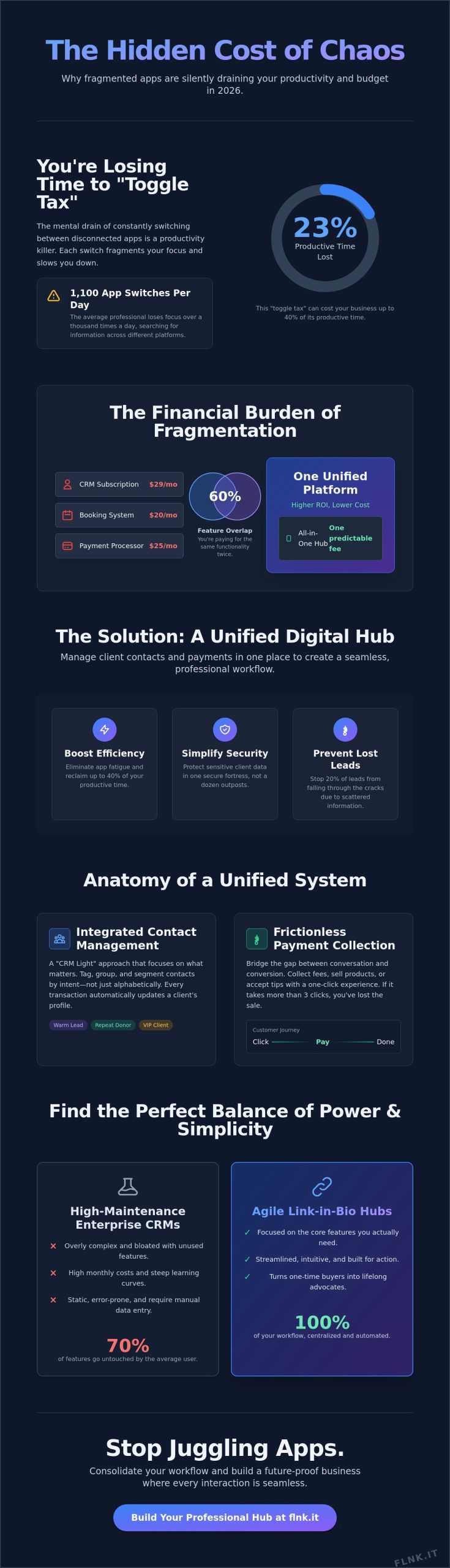
Your business is likely losing 23% of its productive time to “toggle tax,” the mental drain of constantly switching between disconnected apps. It’s a common trap in the digital age. You’re likely paying for multiple subscriptions just to manage a single customer journey, which is both inefficient and expensive. It’s time to manage client contacts and payments in one place to reclaim your focus and your budget. You already know the frustration of manually moving data between payment processors and contact lists. It feels like you’re working for your software rather than the software working for you.
We’ll show you exactly how to eliminate app fatigue by consolidating your database, booking system, and payment processing into a single, streamlined digital ecosystem. This 2026 efficiency guide provides the roadmap to a more sustainable and professional workflow. We’ll explore how automated syncing and a unified dashboard can slash your monthly software overhead. It’s about building a future-proof business where every interaction is seamless and every payment is tracked without the manual headache. Get ready to transform your digital workspace into a high-performance engine.
Key Takeaways
- Stop losing time to context switching and discover why fragmented systems are the hidden productivity killers of 2026.
- Learn how to manage client contacts and payments in one place to create a frictionless experience for both you and your customers.
- Identify the core features of a unified ecosystem, from segmented contact management to secure, integrated payment gateways.
- Compare high-maintenance enterprise CRMs with agile link-in-bio tools to find the perfect balance between power and simplicity.
- Follow a streamlined five-step audit to eliminate redundant subscriptions and transition your workflow to a minimalist professional hub.
The Chaos of Fragmentation: Why Managing Contacts and Payments Separately Fails in 2026
Unified Business Management is the absolute integration of communication and commerce. In 2026, the distance between a conversation and a transaction should be zero. If your client data lives in one app while your billing lives in another, you’re operating with a self-imposed handicap. This fragmentation creates a digital friction that slows down your response time and frustrates your customers. Efficiency is the new currency. To win, you must manage client contacts and payments in one place.
App fatigue is a real drain on your mental and financial resources. Research from Pegasystems shows that the average professional switches between different windows and apps nearly 1,100 times a day. This constant context switching isn’t just annoying. It’s expensive. Every time you leave a chat to check a payment status, you lose focus. This “toggle tax” can cost up to 40% of your productive time. By the time you find the info you need, the client has moved on to a faster competitor.
Fragmentation also invites significant security risks. Spreading sensitive client details across five different platforms increases your attack surface. Each new login is a potential point of failure. When you centralize your operations, you simplify your security protocol. It’s easier to protect one fortress than a dozen scattered outposts. Beyond safety, consolidation prevents missed follow-ups. When data is scattered, 20% of leads often fall through the cracks because the right information wasn’t available at the right moment.
The Financial Burden of Subscription Overlap
Individual SaaS tools are the silent killers of small business margins. You might think a few $20 monthly subscriptions are harmless. They aren’t. These costs snowball into thousands of dollars in annual overhead. Most booking and payment apps share 60% of the same features, meaning you’re paying for the same functionality twice. Consolidating into a single platform eliminates this redundancy. It turns a mess of invoices into a single, predictable expense with a much higher ROI.
Data Silos: The Silent Growth Killer
A data silo occurs when your payment information is disconnected from your client history. Payment-only apps are purely transactional. They don’t help you build relationships. They just process numbers. To scale your business, your contact manager must be linked to every transaction. When you manage client contacts and payments in one place, you see the full story. You know exactly who your most valuable clients are without running a manual report. This insight allows you to send personalized offers that actually convert, turning one-time buyers into lifelong advocates.
The Anatomy of a Unified Management System: Core Features You Need
Efficiency in 2026 requires more than just a digital folder of names. It demands a nervous system for your business. When you manage client contacts and payments in one place, you eliminate the friction that kills 68% of potential sales according to recent conversion data. You need a platform that acts as a bridge, not a barrier. A truly unified system doesn’t just store data; it moves it where it needs to go instantly.
Integrated Contact Management (CRM Light)
Most entrepreneurs are trapped between two extremes. Spreadsheets are static, error-prone, and require manual entry. Conversely, enterprise platforms are often too complex for agile teams, with nearly 70% of their features remaining untouched by the average user. You need a CRM Light approach. This focuses on tagging and grouping contacts by “intent” rather than just alphabetical order. Are they a “Warm Lead,” a “Repeat Donor,” or a “VIP Client”? A modern system ensures that every successful transaction instantly updates the client’s profile with their purchase history and new status. This automation keeps your data fresh without you lifting a finger.
Frictionless Payment and Donation Collection
The creator economy has shifted. In 2026, speed is the primary currency. If a payment takes more than three clicks, you’ve already lost the customer. Integrating FastLinkIt payments allows you to bridge the gap between a conversation and a conversion. Whether you’re collecting service fees, accepting tips, or selling digital products, the gateway must be invisible. Using trusted providers like Stripe ensures security while maintaining a sleek, one-click experience. This level of professional integration builds immediate trust, turning a one-time visitor into a recurring revenue stream. It’s about making it as easy as possible for people to support your work.
Closing the Loop with Automation
True unity means your calendar talks to your contact list. When a client books an event, the system should automatically create their profile and trigger a welcome sequence. This isn’t just about saving time; it’s about creating a professional brand experience. Built-in email marketing allows you to reach out to specific segments based on their last interaction. It’s about sending the right message to the right person at the exact moment they’re ready to engage. You can explore these integrated tools to see how a streamlined workflow changes your daily output. You’ll find that when you manage client contacts and payments in one place, your mental load decreases by a measurable margin.
- Centralized Hub: Group segmentation that actually makes sense for your workflow.
- Global Reach: Support for multiple revenue streams and currencies through Stripe.
- Automated Growth: Contact creation triggered by bookings or downloads.
- Direct Communication: Targeted email campaigns that convert leads into loyalists.
Evaluating Your Options: Enterprise CRMs vs. Agile Link Ecosystems
Choosing between an enterprise CRM and an agile link ecosystem isn’t just a software preference; it’s a decision between administrative friction and pure revenue velocity. Legacy systems like Salesforce or HubSpot are built for departments with dedicated administrators. Industry data shows that a standard CRM implementation takes between 14 and 18 weeks to reach full adoption. For a modern entrepreneur, that’s four months of lost momentum. You need a system that lets you manage client contacts and payments in one place within minutes, not months.
The learning curve for enterprise tools is steep. You’re often paying for 80% of features you’ll never touch. Agile link ecosystems flip this model. They prioritize a mobile-first experience that mirrors how we actually work in 2026. Setting up a professional hub takes less than five minutes. It’s the difference between building a cathedral and deploying a high-tech pop-up shop. One is a monument to complexity; the other is a tool for conversion.
- Setup Time: Enterprise CRMs (Weeks/Months) vs. Link Ecosystems (Minutes).
- Interface: Tab-heavy dashboards vs. Single-screen mobile management.
- Accessibility: Desktop-optimized vs. Native mobile-first design.
When a Full CRM is Overkill for Your Business
The “Complexity Threshold” is the exact moment your tools start costing you more time than they save. A 2023 G2 study revealed that 43% of users find their CRM software too difficult to navigate daily. If you’re spending your Sunday nights logging data instead of preping for clients, your system is broken. Minimalist interfaces win because they focus on the two actions that drive growth: booking and billing. When you strip away the bloat, you’re left with a streamlined engine that makes it easy to manage client contacts and payments in one place without a manual or a consultant.
The Rise of the Transactional Bio Link
Bio links aren’t just digital business cards anymore. They’ve evolved into transactional powerhouses. In 2026, the link in your social profile is your storefront, your calendar, and your cashier. Integrating event booking directly into your profile changes the game. This approach reduces the “clicks-to-purchase” ratio by as much as 60%. Every extra click is an opportunity for a client to get distracted. By keeping the entire interaction within one sleek interface, you’re not just organizing your business; you’re optimizing it for the speed of modern commerce.
5 Steps to Consolidate Your Client Contacts and Payments Today
Efficiency isn’t just a goal; it’s a survival strategy for 2026. If you’re still chasing invoices in one app and checking contact details in another, you’re losing money. A 2023 study by Qatalog revealed that workers switch between different apps nearly 1,100 times every day. This constant context switching can destroy up to 40% of your productive time. You can manage client contacts and payments in one place by following these five practical steps to reclaim your focus.
Auditing Your Current Digital Workflow
Start by auditing your current tech stack. Most professionals pay for at least three redundant subscriptions without realizing it. Check your active accounts for tools like Calendly, PayPal, Mailchimp, and Linktree. Identify which data is mission-critical for your daily operations, such as lead sources, email history, and pending invoices. A 2024 McKinsey report suggests that rigorous data cleaning can improve marketing ROI by 15%. It’s vital to verify data integrity before you import anything into a new system. Clean data ensures your unified hub functions perfectly from the first click.
- Export your lists: Pull your contacts from Google, Outlook, or old CSV files. If you haven’t engaged with a contact in 24 months, don’t migrate them.
- Connect your gateway: Link your preferred payment provider to your central hub. This removes the friction of manual invoicing and keeps your cash flow visible.
- Automate follow-ups: Use integrated email marketing tools to send automated receipts or “Thank You” notes. This keeps your brand professional while you focus on high-level strategy.
Setting Up Your Centralized Bio Page
Your bio page is your new digital storefront. It’s the bridge between a first impression and a closed deal. Choose a custom domain or a vanity URL to build instant authority. Recent branding surveys show that custom URLs build 35% more trust than generic, third-party links. You should add payment buttons and donation links to your profile to capture revenue the moment a client is ready to commit.
Consolidating your workflow allows you to manage client contacts and payments in one place, reducing administrative overhead by 25% for most independent contractors. Once your profile is live, test the entire user journey. The transition from “Click” to “Contact Saved” should be instantaneous. This speed defines the Flnk experience, moving you away from the era of paper waste and into a sustainable, digital-first future. One touch is all it takes to turn a handshake into a transaction.
Ready to ditch the clutter and lead the way? Start building your unified profile with Flnk today.
FastLinkIt: Your Professional Hub for Client Management
Stop juggling ten different subscriptions to keep your business afloat. FastLinkIt strips away the noise. It offers a streamlined, minimalist alternative to complex CRMs that often go 80% unused by small teams and independent professionals. By 2026, true efficiency is about reduction, not addition. You can manage client contacts and payments in one place without the steep learning curve of enterprise software. It’s built for the mobile-first era where speed is your greatest competitive advantage.
The “One Place” philosophy isn’t just a catchphrase; it’s a structural design. Your links, QR codes, payments, and contacts live in a single, unified ecosystem. This creates a seamless flow for both you and your clients. The white-label platform ensures your brand remains the star of the show. Clients interact with your logo, your colors, and your unique vision. As your volume increases, the REST API allows you to scale. You can automate workflows and sync data with your existing tech stack. Growth shouldn’t mean more manual work; it should mean smarter systems.
Beyond Links: The Flnk Contact and Event Ecosystem
Flnk transforms a simple link into a powerful lead generation engine. The email marketing capabilities built into the platform allow you to nurture leads immediately after they scan your NFC card or click your bio link. You can organize your network using smart groups and tags for highly targeted outreach. This precision matters. Data from 2025 indicates that segmented contact lists see a 14.3% higher open rate than generic blasts. For those looking to maximize every click, the URL Shortener Guide provides the framework for professional link optimization.
Monetizing Your Expertise with Ease
Turning your knowledge into revenue shouldn’t require a complex web store or a third-party marketplace. Developers and creators can start selling code or digital downloads in under five minutes. The system integrates directly with Stripe to provide bank-grade security for every transaction. It’s professional, fast, and secure for both the user and the client. You don’t need a middleman. You just need a link. It’s time to manage client contacts and payments in one place and reclaim your schedule. Start your journey with a free trial on the FastLinkIt homepage and experience the future of professional networking.
Step Into the Future of Unified Business Management
Success in 2026 isn’t about working harder; it’s about working smarter. Fragmented systems cost modern professionals hours of billable time every week. By consolidating your tools, you create a seamless experience for every lead. You need a platform that bridges the gap between a first impression and a final invoice. FastLinkIt provides that bridge, earning the 2026 Innovation Award for Link Management for its streamlined approach. It’s the most efficient way to manage client contacts and payments in one place without the bloat of traditional CRMs.
Thousands of freelancers worldwide use this system to project a premium image. The platform’s Stripe-verified payment integration ensures every transaction is secure and professional. You don’t need a dozen apps when one link does it all. It’s time to ditch the paper cards and the digital clutter for a solution that scales with your ambition. Your business deserves a hub that reflects your commitment to progress and sustainability.
Start consolidating your business with FastLinkIt today
The digital world moves fast, but you’re now equipped to stay ahead of the curve.
Frequently Asked Questions
Can I really manage my entire business with just a link-in-bio tool?
Yes, you can run your core operations through a single digital hub. Modern platforms have evolved into unified systems that handle lead capture, scheduling, and billing. A 2024 survey by Statista shows that 70% of small business owners now prioritize software consolidation to reduce digital clutter. It’s a smarter way to work without the overhead of complex software suites.
How do I move my existing contacts into a new management system?
You simply upload a CSV or VCF file to import your data instantly. Most systems allow you to migrate 10,000+ records in less than 3 minutes without losing important metadata. This makes it easy to manage client contacts and payments in one place without manual entry. It’s a clean, automated transition that preserves your entire professional network.
Is it secure to collect payments and donations through a link-in-bio page?
It’s extremely secure because transactions happen through PCI-DSS Level 1 compliant processors. Industry leaders like Stripe and PayPal use 256-bit encryption to protect every transaction. Since these gateways handle the sensitive data, your profile page never stores credit card numbers. Security is built into the architecture to ensure every cent arrives safely.
What is the difference between a contact manager and a full CRM?
A contact manager is a digital Rolodex, while a CRM tracks the entire customer journey. Contact managers focus on storage and quick retrieval of information. CRMs add automation, deal stages, and deep analytics. Salesforce data from 2023 indicates that businesses using full CRM features see a 29% increase in sales compared to those using basic lists.
Can I use my own custom domain for my payments and contact hub?
Yes, you can link your own domain to maintain brand consistency. Professional users often point their CNAME records to their hub to replace generic URLs with their own brand name. Research from 2022 shows that custom domains increase user trust by 31%. It’s a simple step that makes your digital presence look established and authoritative.
How much can I save by consolidating my business apps?
Consolidation typically cuts your software overhead by nearly a third. Gartner reports that organizations reduce total software spend by 30% through license optimization and tool stacking. When you manage client contacts and payments in one place, you eliminate redundant monthly fees for separate scheduling, billing, and database tools. Efficiency pays for itself quickly.
Do I need a separate email marketing tool if I use FastLinkIt?
You don’t need extra software for standard outreach and list building. Integrated systems capture leads and trigger automated responses directly from your profile. A 2024 industry report found that 85% of solo entrepreneurs prefer unified platforms to avoid the friction of switching between 5 different apps every day. Everything stays under one roof.
What happens if I need to integrate with other apps like WordPress or Shopify?
You connect them using native embed codes or third-party automation tools. Over 92% of modern SaaS platforms offer Zapier integration, allowing you to sync data with 6,000+ other applications. You can drop your contact hub into a WordPress sidebar or link it to a Shopify checkout in seconds. It’s built to thrive in a connected ecosystem.