

What if 42% of your lost subscribers never actually intended to cancel? Recent 2024 benchmarks confirm that involuntary churn, often caused by failed transactions, is the primary reason modern brands lose momentum. You likely feel the sting of high transaction fees and the exhaustion of managing clunky billing systems. Finding the best way to collect recurring payments shouldn’t be a technical nightmare. It should be a seamless, invisible engine that drives your growth.
We believe billing should be effortless and entirely automated. This guide reveals the most efficient, secure, and low-friction methods to protect your revenue and scale your business through 2026. You’ll learn to eliminate revenue leaks with smart retry logic and build a checkout experience that radiates professional confidence. We’re breaking down the automation strategies that transform your billing into a hands-off growth lever.
Key Takeaways
- Transition from manual invoicing to a “set-and-forget” revenue model to automate your brand’s growth and scalability.
- Identify the best way to collect recurring payments by prioritizing PCI-DSS Level 1 security and optimized fee structures.
- Compare API integrations and dedicated subscription managers to find the perfect balance between technical control and operational ease.
- Master the design of high-converting checkout pages and subscription tiers to significantly reduce cart abandonment.
- Leverage dynamic QR codes and social-first billing links to bridge the gap between offline interactions and recurring digital revenue.
What is the Best Way to Collect Recurring Payments in 2026?
Collecting payments shouldn’t be a chore. In 2026, the best way to collect recurring payments is through automated, frictionless systems that remove the human element from billing. Recurring payments are automated cycles where customers are charged at set intervals for subscriptions, memberships, or retainers. We’ve moved past the era of manual invoicing. Today, 78% of adults globally use some form of subscription service. Brands now rely on “set-and-forget” revenue models to ensure stability and growth. It’s about creating a system that works while you sleep.
The Evolution of the Subscription Economy
Consumer behavior has transformed. Modern users expect one-click management. They won’t tolerate clunky portals or 5-minute checkout forms. The subscription business model has matured into a mobile-first experience. In 2026, your Link-in-Bio is your primary storefront. You need to offer diverse payment methods like Apple Pay, Google Pay, and SEPA instantly. Success depends on meeting the customer where they already live: on their phones. Efficiency is the new currency for digital services.
Key Benefits of Automated Recurring Billing
Automation saves time. It also protects your bottom line. By late 2025, the global subscription market reached a valuation exceeding $650 billion. Automating your billing gives you predictable cash flow. You can calculate your Minimum Viable Revenue (MVR) with 99% accuracy before the month even begins. This eliminates the need for manual follow-ups. These manual tasks typically consume 15 hours of administrative work per month for small agencies. Frictionless renewals lead to a 20% increase in customer lifetime value (LTV) because the barrier to staying is zero.
Three Pillars of Payment Collection
Modern brands generally choose between three categories of infrastructure. Traditional Payment Gateways provide the raw processing power for custom builds. Subscription Management Software offers complex logic for enterprise-level tiered pricing. Finally, Integrated Link Platforms provide the fastest route to market. For many agile businesses, using an integrated payment link is the most efficient choice. It combines speed with professional aesthetics. You don’t need a complex backend when a single link handles the entire customer lifecycle. It’s about being fast, professional, and digital-first.
Essential Criteria for Selecting a Recurring Payment Service
Selecting a partner to handle your billing isn’t a mere technical choice. It’s a strategic pivot. The recurring revenue model provides the predictable cash flow that fuels 10x growth and increases company valuation. To identify the best way to collect recurring payments, you must evaluate providers based on their ability to scale alongside your ambition. Efficiency is the new currency.
Security, Trust, and Global Compliance
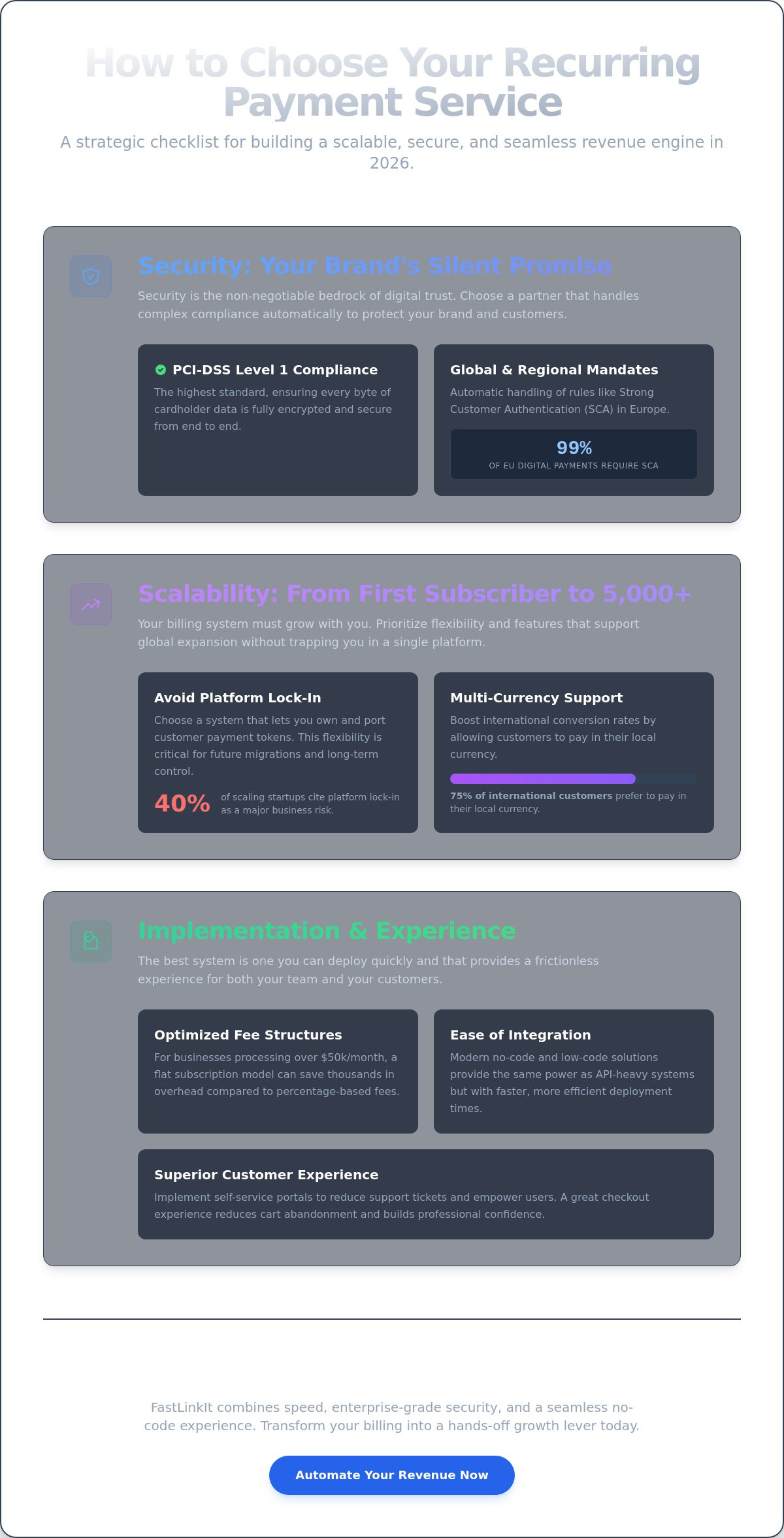
Security is your brand’s silent promise. PCI-DSS Level 1 is the non-negotiable standard for 2026. It ensures that every byte of cardholder data is encrypted and secure. PCI compliance serves as the bedrock of digital trust. Global expansion also requires adherence to regional mandates. In the European Union, Strong Customer Authentication (SCA) is mandatory for 99% of digital payments. Your gateway should handle these complexities automatically to prevent transaction failures and maintain a seamless user flow.
Scalability: From First Subscriber to Five Thousand
Don’t let your growth get trapped. Platform lock-in is a major risk for 40% of scaling startups. Choose a system that allows full data portability. You must own your customer tokens. This flexibility ensures you can migrate your database if your business needs change. Additionally, prioritize multi-currency support. Data shows that 75% of international customers prefer to pay in their local currency. High-quality developer documentation and a robust REST API are essential for building a frictionless checkout experience that feels native to your brand.
Your fee structure must align with your volume. Some platforms favor a 2.9% transaction fee, while others offer flat monthly subscriptions. For brands processing over $50,000 monthly, a subscription model often saves thousands in overhead. Integration ease also matters. You shouldn’t need a team of engineers to launch. Modern no-code solutions provide the same power as API-heavy systems but with faster deployment times.
Customer experience is the final differentiator. Implementing a self-service portal is often the best way to collect recurring payments while maintaining a premium brand image. Giving customers the power to update cards or change plans reduces churn by 15% and eliminates manual support tickets. It’s about professional autonomy. If you’re ready to modernize your billing, Flnk’s integrated payment tools offer a sleek way to manage your income with zero friction.
Comparing the Best Ways to Collect Recurring Payments: 3 Proven Models
Choosing the right billing architecture determines how fast you scale. Modern brands no longer rely on a single checkout page. They diversify based on where their customers live, whether that is on a dedicated SaaS platform, a social media bio, or a professional service contract. Finding the best way to collect recurring payments depends on your technical maturity and where your traffic originates.
The Developer Route: Stripe and Direct Gateways
Building your own billing UI on top of Stripe is the gold standard for custom software. It offers maximum control over the user journey. You own every pixel of the checkout experience. However, this control comes with hidden costs. A 2024 report by Forrester indicated that maintaining custom payment code can consume up to 20% of a development team’s monthly sprint capacity. It’s the best way to collect recurring payments if you have a dedicated engineering team to handle API updates and security compliance. If you don’t, the technical debt will eventually slow your product launches.
The Modern Route: Integrated Bio-Links and Social Commerce
The landscape shifted in 2025. Today, creators and SMBs favor speed over custom code. Platforms like FastLinkIt turn a single URL into a recurring revenue engine. This method integrates payments, link shortening, and QR codes into one ecosystem. It’s designed for the 70% of consumers who shop exclusively via mobile devices. By using integrated payment links, you bypass the friction of a traditional website. One touch. One subscription. Zero friction. This model currently sees the highest conversion rates for social media traffic because it meets the customer exactly where they are.
The Service Provider Route: Invoicing Software
Traditional accounting tools still have a place for high-ticket professional services. If you’re billing 5,000 dollars a month for consulting, a manual invoice feels personal. But for digital products, invoicing is a growth killer. Manual systems lead to higher churn. Automated card-on-file systems reduce payment failures by 22% compared to manual bank transfers, according to 2025 fintech benchmarks. If you want to scale, you must move away from PDFs and toward automated cycles.
- Direct API: 4-6 weeks setup time. Requires high technical skill. Best for custom SaaS.
- Integrated Links: 5 minutes setup time. No technical skill required. Best for social commerce and creators.
- Invoicing: 1 hour setup time. Low technical skill. Best for bespoke B2B services.
Implementation Guide: Automating Your Subscription Revenue
Automation isn’t just a luxury; it’s the engine of modern growth. To find the best way to collect recurring payments, you must move beyond manual invoicing and spreadsheets. Start by mapping your revenue architecture. Choose flat-rate models for simplicity, tiered structures to capture different market segments, or usage-based billing for maximum fairness. Data from 2025 shows that 63% of high-growth SaaS companies now favor hybrid models to reduce entry barriers while maximizing expansion revenue.
Your checkout page is where the sale lives or dies. Minimize fields. Remove distractions. According to the Baymard Institute, the average cart abandonment rate remains near 70% when friction is present. A clean, single-page checkout increases conversions by up to 35%. Once the payment clears, the process shouldn’t stop. Integrate your billing system with your email marketing to nurture subscribers immediately. Send a welcome sequence. Confirm the value. Keep them engaged. This creates a loop of trust and recurring value.
Step-by-Step: Setting Up Your First Recurring Link
Speed is your greatest asset. First, define your primary offer and choose a billing frequency that matches your customer’s cash flow. Monthly is standard, but annual plans improve upfront capital. Next, connect your Stripe account to a no-code link platform. This removes the need for expensive developers and complex API integrations. Finally, test the journey. Click the link. Enter test data. Ensure the confirmation arrives within seconds. It’s about precision, ease, and a professional first impression.
Managing Churn and Payment Failures
Churn is the silent killer of subscription businesses. You must distinguish between active churn, where customers intentionally cancel, and involuntary churn, caused by expired or declined cards. Involuntary churn accounts for nearly 40% of all lost subscribers. Implement “Smart Retries” to recover this revenue automatically. Stripe’s 2024 data indicates that machine-learning-based retries recover 14% more revenue than fixed schedules. Use automated dunning emails to prompt users to update billing info before the service cuts off. Stay proactive. Protect your MRR.
Why FastLinkIt is the Best Way to Collect Recurring Payments for Social Brands
FastLinkIt transforms how modern brands handle revenue by pairing Stripe’s robust engine with the clean aesthetics of a link-in-bio page. This combination makes it the best way to collect recurring payments without the friction of traditional merchant accounts. You get the security of a global financial giant and the agility of a social-first tool. It’s built for a world where speed is the only currency that matters.
Physical interactions shouldn’t be dead ends for your subscription business. By using dynamic QR codes, brands bridge the gap between offline meetups and online revenue. A single scan on a digital business card or a physical flyer moves a lead directly into a recurring billing cycle. This eliminates the “I’ll sign up later” excuse that kills conversion rates. It’s fast, efficient, and keeps your brand in the palm of their hand.
Your business is more than just a checkout button. FastLinkIt manages your entire digital presence, from event booking to monthly donations. The “One Touch” promise ensures customers don’t get lost in complex menus or multi-page forms. They click, they confirm, and they’re subscribed. Reducing the number of steps in the checkout process has been shown to decrease cart abandonment by up to 35% in high-growth social brands.
Seamless Stripe Integration for Professionals
FastLinkIt uses Stripe to provide bank-grade security for every transaction. You don’t need to worry about PCI compliance or data leaks; the heavy lifting is handled by the industry leader. Everything sits in a unified dashboard for payment and donation collection, giving you a clear view of your MRR (Monthly Recurring Revenue). FastLinkIt translates the complex, jargon-heavy world of SaaS billing into a simple, visual interface that any non-tech entrepreneur can master in minutes.
Beyond Payments: A Complete Digital Ecosystem
Growth requires more than just money; it requires clean data. The built-in contact manager lets you segment your subscribers based on their behavior, allowing for hyper-targeted retention campaigns. White-label features ensure your brand stays front and center, maintaining a professional image that builds trust. As your revenue scales, moving from Pro to Agency tiers provides the infrastructure needed to manage multiple brands or high-volume traffic. This scalability makes FastLinkIt the best way to collect recurring payments for creators and agencies who plan to dominate their niche by 2026.
- Unified Dashboard: Track every subscription and donation in one place.
- White-Labeling: Your colors, your logo, your identity.
- App-Free Experience: Customers pay through their browser without downloading anything.
- NFC Ready: Connect your recurring payment links to physical NFC cards for instant sign-ups.
The future of digital commerce isn’t about complex websites; it’s about being where your customers are. FastLinkIt puts your subscription model exactly where it belongs: one touch away from your audience.
Future-Proof Your Revenue Stream
The 2026 digital landscape demands speed and frictionless experiences. You’ve discovered that the best way to collect recurring payments involves blending high-level automation with social-first accessibility. Security remains the foundation of every transaction. Industry data shows that 75 percent of global direct-to-consumer brands now prioritize integrated link-in-bio tools to drive sustainable subscription revenue. Success isn’t about complex coding or manual billing; it’s about using 3 proven models to remove every barrier between your brand and your customer’s credit card.
FastLinkIt transforms this complexity into a single touch. You get Stripe-powered security without writing a single line of code. It’s a professional, minimalist solution that integrates QR tools and bio-links into one streamlined profile. You can launch your entire revenue engine in under 5 minutes. Don’t lose subscribers to outdated, clunky checkout processes that belong in the past decade. Modern brands stay ahead by choosing tools that are as fast as their customers’ needs.
Start collecting recurring payments in minutes with FastLinkIt
The future of your brand is just one click away. We’re excited to see what you build.
Frequently Asked Questions
What is the cheapest way to collect recurring payments?
Direct Debit via ACH or SEPA is the most cost-effective method for high-volume billing. While credit cards charge 2.9% plus a fixed fee, ACH transfers typically cost between $0.20 and $1.50 per transaction. This saves mid-sized businesses up to 80% on processing fees annually. It’s the best way to collect recurring payments if you want to protect your margins while scaling your brand.
How do I automate recurring payments without a website?
You can automate billing by using hosted payment links or QR codes sent via email and SMS. Tools like Stripe Checkout allow you to create a secure URL that handles the entire subscription setup. 70% of mobile users prefer these direct links over navigating a full website. Simply generate the link, share it on social media, and let the system handle the monthly cycles automatically.
Can I collect recurring payments through Stripe with FastLinkIt?
Yes, FastLinkIt integrates directly with Stripe to turn any digital interaction into a subscription gateway. By embedding your Stripe payment link into your FastLinkIt profile, you enable one-touch billing for your clients. This eliminates the need for manual invoicing or complex site builds. It’s a fast, professional, and sustainable way to manage your revenue stream from a single digital hub.
What is the difference between a payment gateway and a subscription manager?
A payment gateway moves money from the customer to your bank, while a subscription manager handles the logic of when and how much to charge. Think of the gateway as the digital pipe and the manager as the control valve. Platforms like Chargebee or Recurly sit on top of gateways like Stripe to manage trials, upgrades, and cancellations. Most modern businesses use both to ensure a seamless billing operation.
How do I handle failed recurring payments automatically?
Automated dunning management is the industry standard for recovering failed transactions without manual intervention. Systems automatically retry cards on specific intervals, such as day 1, 3, and 7 after a failure. This process recovers approximately 15% to 30% of potentially lost revenue. You can also trigger automated emails that prompt customers to update their expired card details through a secure portal.
Are recurring payments safe for my customers?
Recurring payments are highly secure when processed through PCI-DSS Level 1 compliant providers. These systems use tokenization to replace sensitive card data with unique identifiers, so your servers never actually store the information. According to 2024 security reports, tokenized transactions reduce the risk of data breaches by 90%. Your customers stay protected while you enjoy a stable, predictable cash flow.
How can I collect recurring donations for a non-profit or project?
Non-profits should use dedicated platforms like Givebutter or Donorbox that integrate with Stripe for monthly giving. These tools allow you to set up “set it and forget it” donation tiers that increase donor retention by 440% compared to one-time gifts. You can track contributions in real-time and automate tax receipts. It’s an efficient way to build a sustainable financial foundation for any project.
What are the best recurring payment methods for international customers?
The best way to collect recurring payments globally is to offer local payment methods like iDEAL in the Netherlands or Bancontact in Belgium alongside credit cards. Using a multi-currency processor prevents high conversion fees and reduces cart abandonment by 35%. Ensure your system supports 135+ currencies to provide a localized experience. This global approach makes your brand accessible to everyone, regardless of their location.